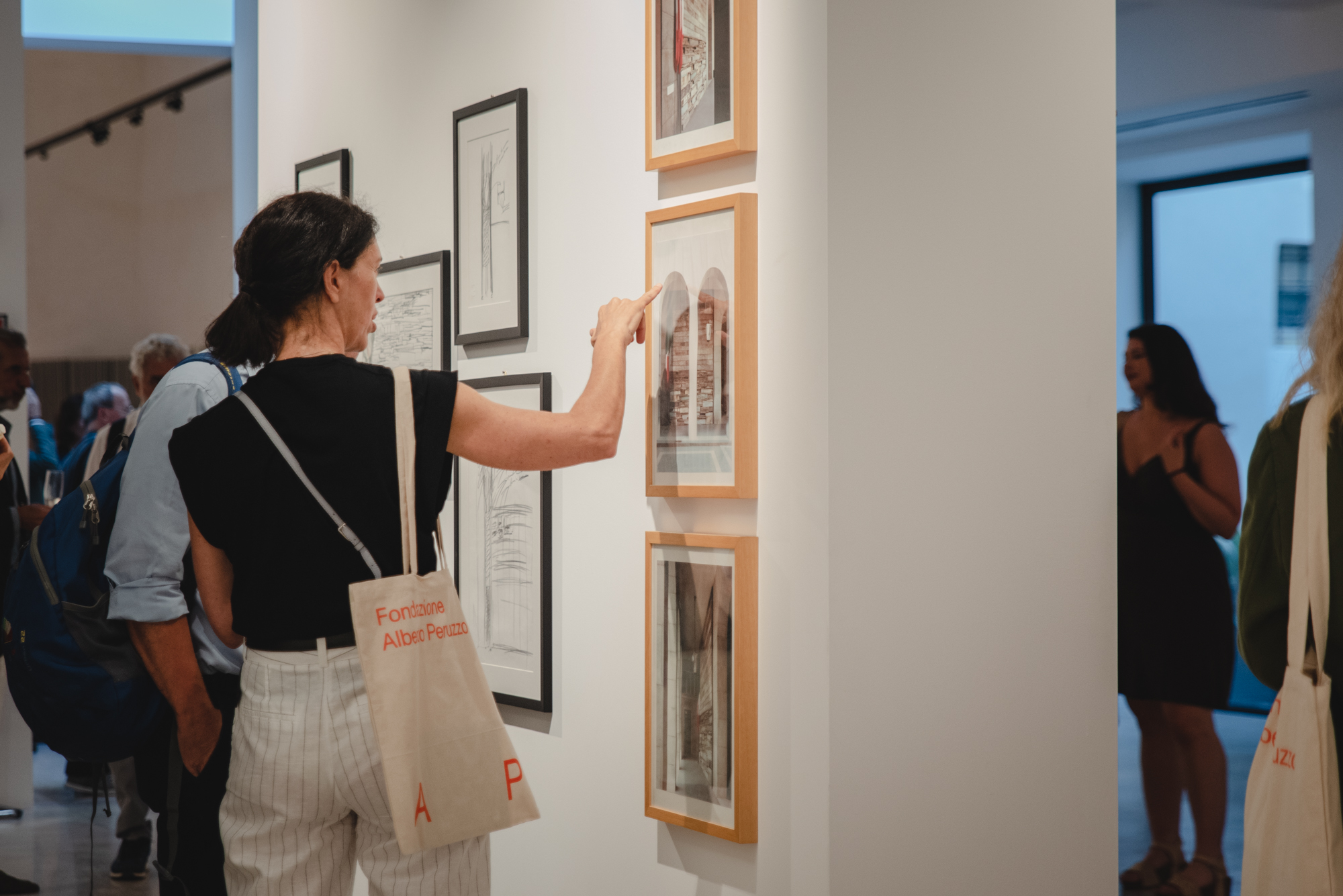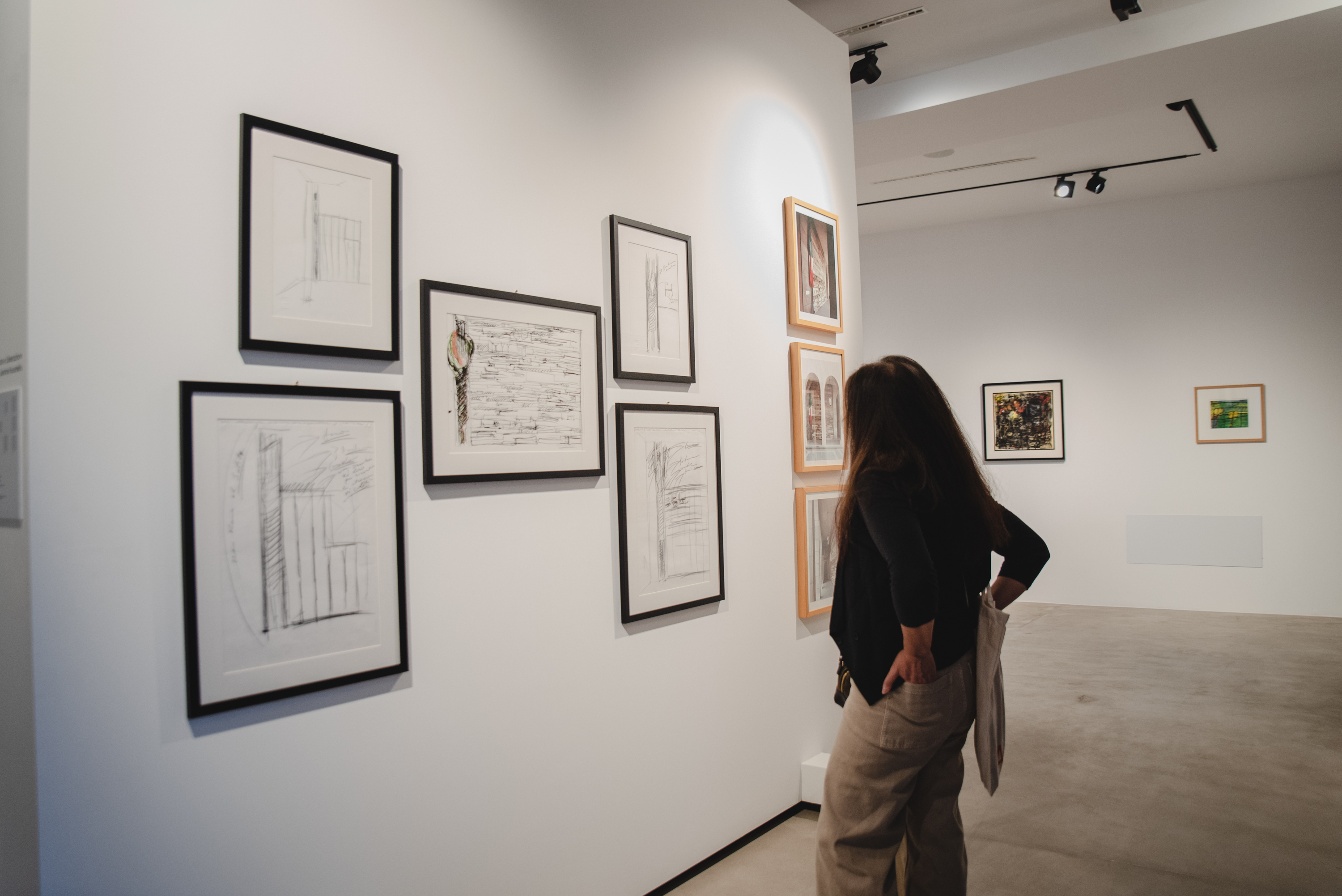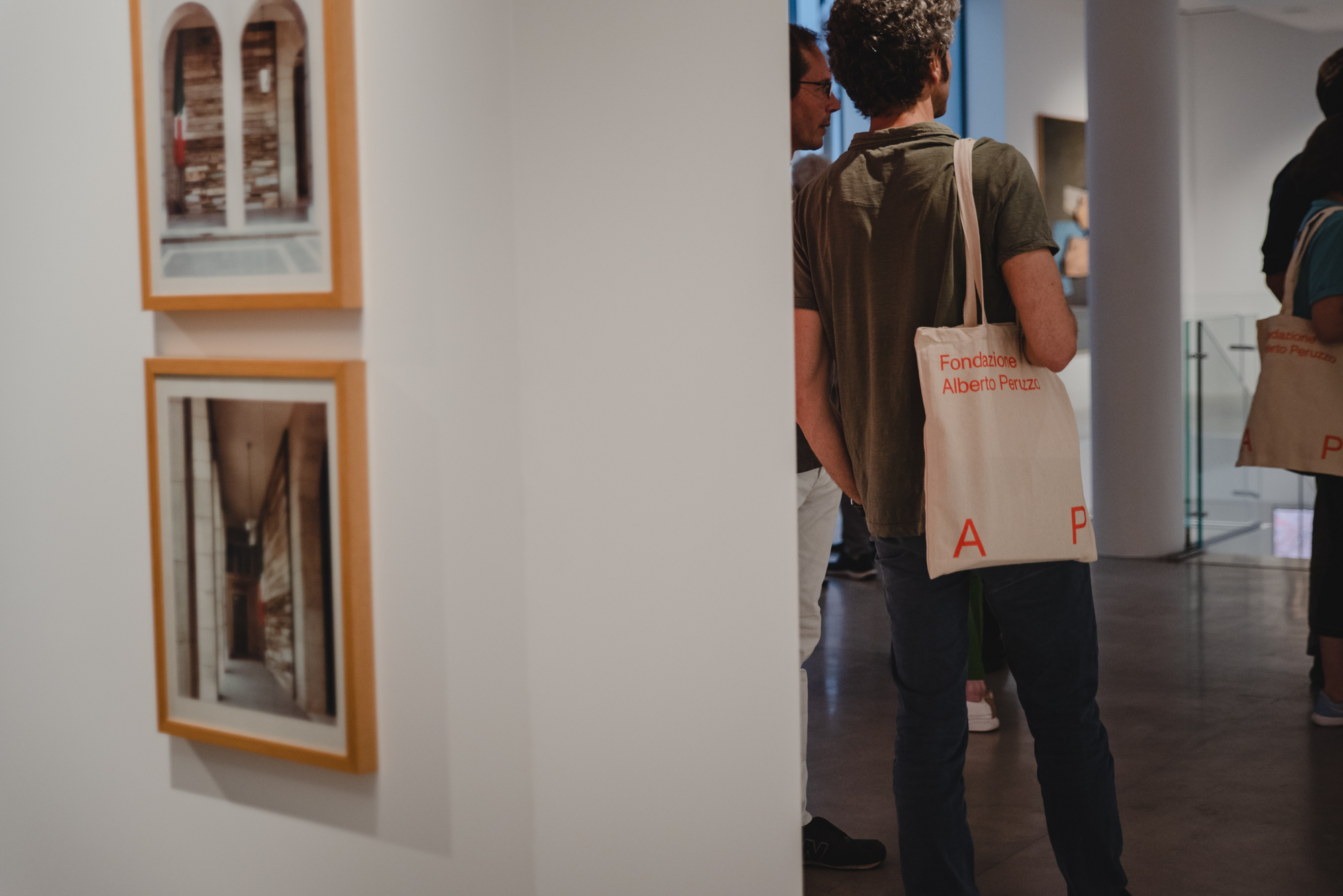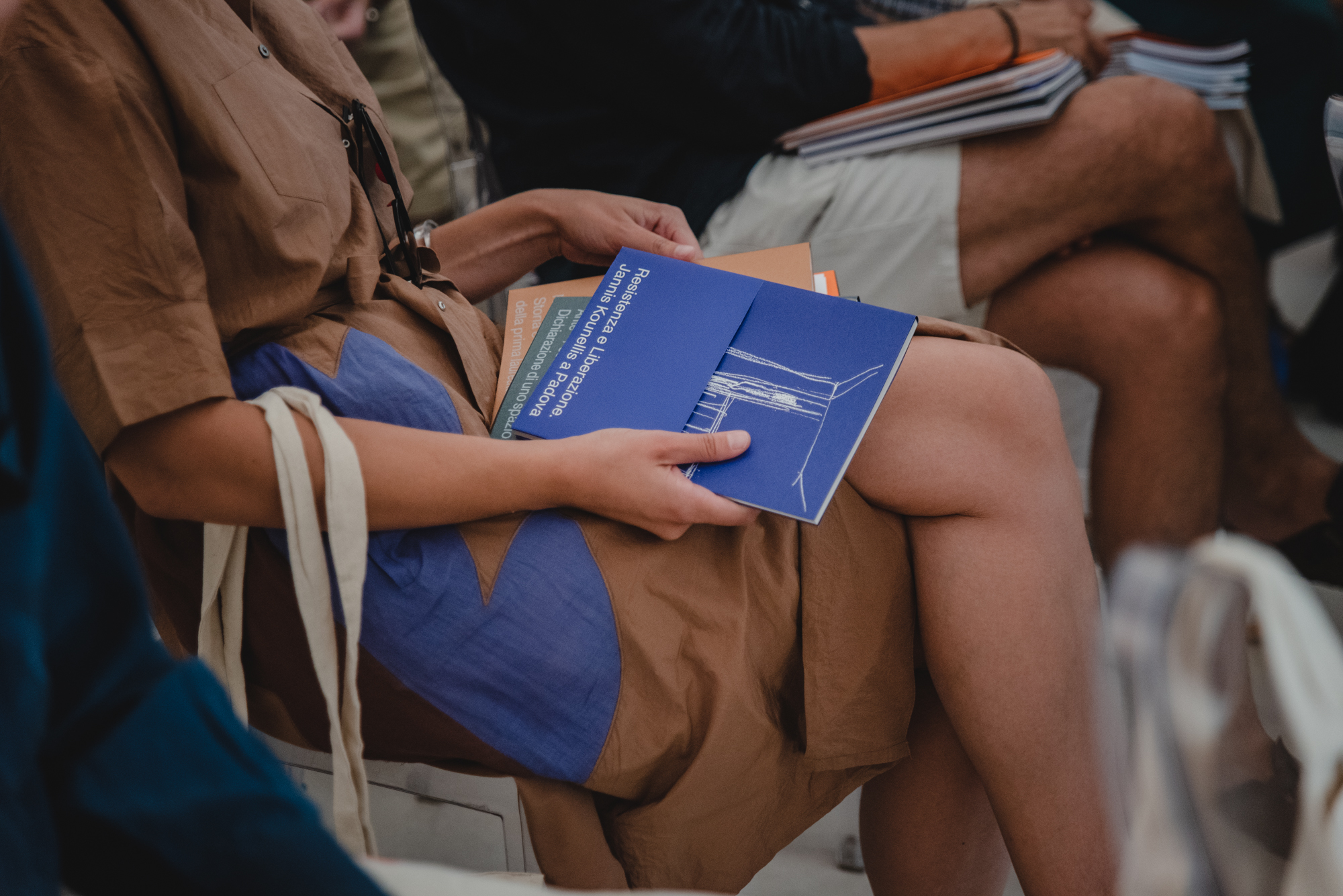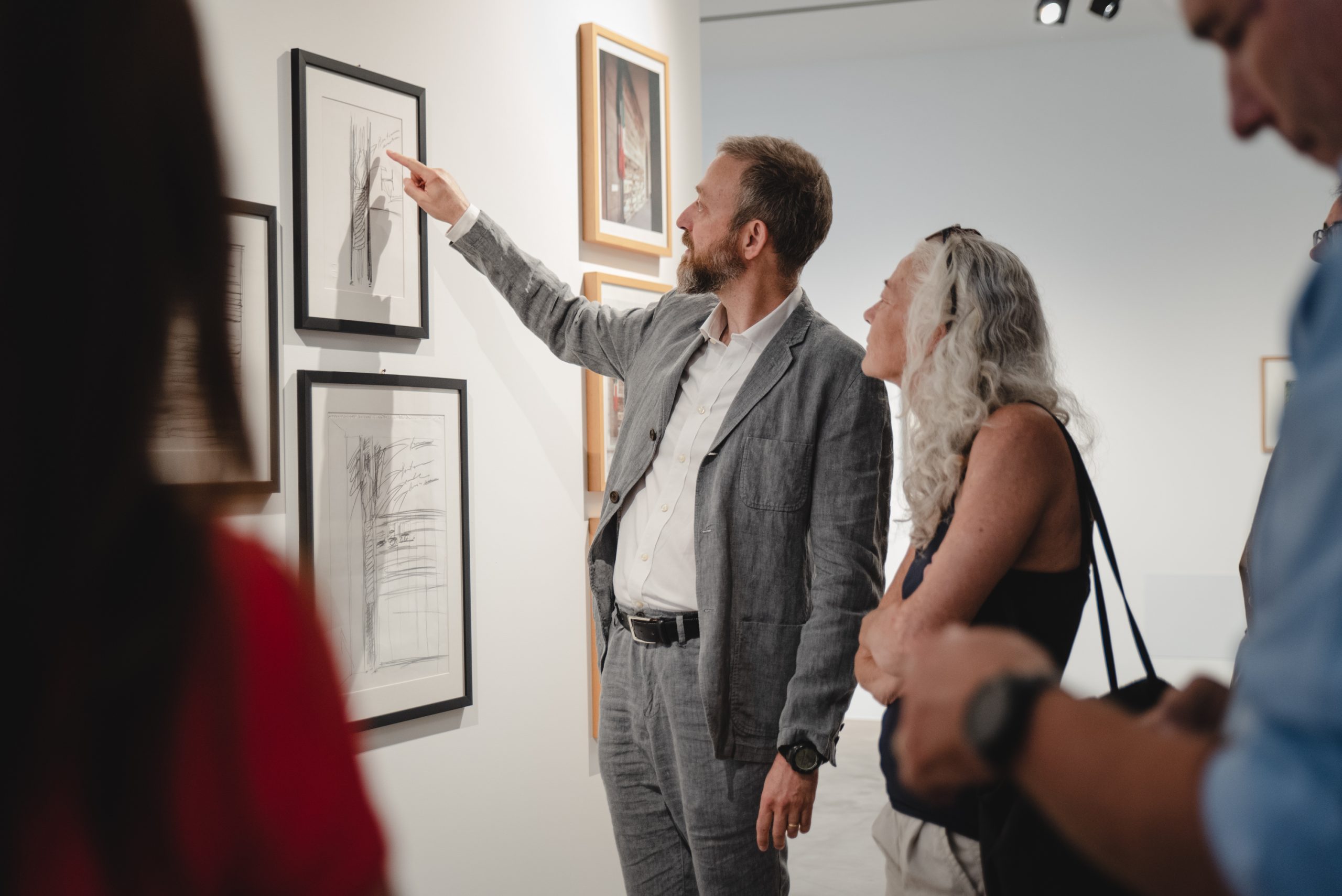
The preparatory studies for the large installation Resistance and Liberation, displayed in the New Courtyard of the Bo, are being presented to the public for the first time today at the Fondazione Alberto Peruzzo. These consist of five sheets, currently preserved in the General University Archive, which were sent by mail to the commissioner and received on January 27, 1995. They allow us to retrace the dynamics of Kounellis’ creative workshop.
With a few cursive strokes, already bearing a physical essence, the artist shapes his vision and develops it aiming for a powerful structure. Four sheets are in pencil, the fifth in ink with limited interventions in colored watercolors.
In the Archive, separate from the sketches but probably included in the same package, there is a brief “project description” (with the author’s printed signature at the bottom). The full text reads:
Two vertical and parallel iron bars (H-shaped), rising from the floor to the attic [sic], holding inside three poles with semi-rolled flags, tied together with a sailor’s rope from a certain height to another, yet to be determined, and inserted into the cavity of the H-shaped bar. To the right of the bars, a wooden construction made of old poles, also placed at a height yet to be established, intended to recall Galileo’s Chair.
A roughly sketched representation, with as little rhetoric as possible, of the ideal values of a new Italy, juxtaposed with a recognizable heritage (through the wooden structure that vaguely refers to Galileo’s Chair).
Naturally, the way of composing using iron and wood in this manner belongs to my artistic experience and has been used on various occasions to formalize my work. These drawings, not detailed, contain the structure of the project.
The fascination with Galileo’s chair is more active than ever in sketch no. 1, which shows a construction where wooden boards are arranged vertically, like those of the chair. This is also evoked by the vertical progression of the structure from right to left, culminating symbolically in the steel beam holding the Italian flags, with the difference that Kounellis breaks into two horizontal levels the diagonal that accompanied the ascent to the chair.
The drawing also presents some notes, legible though with some uncertainty, also because they are not orthographically precise. On the left, the indication “to be raised [?] to the ceiling” establishes the maximum height of the work, reached, in the initial conception, only by the placement of the tricolors.
This is one of two very vague hints expressed by the sketches that consider the relationship with the space, a fundamental factor for Kounellis and for the Padua installation in particular, but that could not yet be specified as the placement would be decided only after the second and decisive site inspection, which took place in mid-March 1995.
Also in the first drawing, the other inscriptions list one by one the materials of the work, revealing the artist’s typical attitude of making the material itself meaningful. Note that the materials are four, a number that evokes the ancient division of the elements: in this case, the “iron,” which is the powerful and reliable element of the beam (more precisely steel in the finished work); the “3 flags,” which are colors and symbols of an ideal; the third element is the “rope” mentioned in the project description but later removed from the final realization.
Regarding this, before mentioning the fourth element, it should be noted that all five studies, despite showing significant revisions, share the idea of the rope dramatically entwining the flags, wrapping them in a spiral that resembles a noose. The rope was widely used by Kounellis between the 1980s and 1990s, often to bind rigid components such as stones or metal parts, thus enhancing the hidden strength in the soft and organic nature of the material. In this case, the rope has an ambiguous meaning: it is something that clings fiercely to the ideal while simultaneously suffocating it.
In the finished work, the three flags, with their steel rods, are simply leaning against the steel beam, a less exuberant solution from an expressive point of view but effective as a “script”: a sort of colored arrow, imprinting the upward movement that in the first sketch is given by the levels of the structure.
Finally, the inscription referring to the fourth element is the richest and most detailed: “a linen partition to recall Galileo’s chair.” The artist’s elaboration stems from the homage, explicit and reaffirmed on every occasion, to the illustrious and tragic professor of the University, one who well understood the torment on the path to freedom.
Study no. 2 reiterates the same structure, except for the rectangular area in the upper right corner, which is not easy to interpret. This is where, in the previous study, the wooden boards give way to the first rise. This should be the moment when the artist decides to absorb it into a uniformly high wall, still lower than the tower of tricolors. There appears a single inscription—the second and last concerning placement that prescribes a distance of “60” centimeters to the left, which is not verifiable in the final work.
Much more significant developments are documented in sketch no. 3, where Kounellis first rotated the boards horizontally, moving away from the Galilean inspiration and rediscovering his characteristic motif of layering, which would indeed become definitive. Additionally, the inclusion of small square or circular shapes among the boards likely refers to heterogeneous fragments that the artist had already experimented with multiple times in previous works.
The inscriptions reaffirm the poetics of the elements: “iron flags rope linen” (followed by a partially erased word underlined, perhaps “residue”). Finally, the wooden backrest is now leveled in height but still below the iron beam.
A detail of the latter, showing the “H” section, is the subject of the fourth study. The beam continues to tower, holding the flags, with the knot clearly visible. The notes reiterate the materials of this part of the work (“flags rope iron”). Although sheet no. 5 still emphasizes the tangle of flags and rope, especially since it is colored, it also finally documents the full-height growth of the wooden wall and its assimilation into a makeshift barricade. Some differences remain compared to the finished work: the stacking is not flattened at the top, and some small circles between the beams perhaps still imagine some object inserts.
The monument, though it would be better described as an “anti-monument”, was inaugurated on May 29, 1995. Nearby, a small plaque reads:
“to the civil faith and the actions of Concetto Marchesi, Egidio Meneghetti, Ezio Franceschini, and all those at the University who were able to unite different ideals and cultures in a harmonious popular struggle to regain freedom for Italy.”
It is the University’s dedication to the professors who, in 1945, made it worthy of the Gold Medal for Military Valor for the Liberation War.