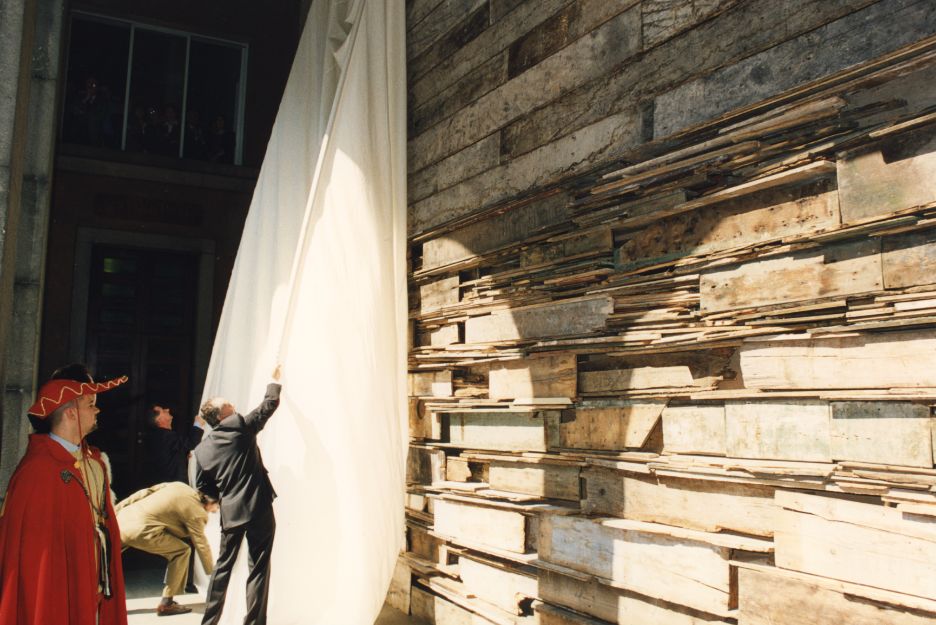
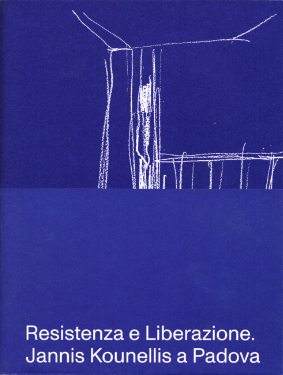
On September 21, 2021, at the Archivio Antico of Palazzo Bo, headquarters of the University of Padua, a press conference was held following the restoration of the artwork “Resistance and Liberation” by artist Jannis Kounellis, located in the Cortile Nuovo. Among the speakers was Michelle Coudray, President of the Kounellis Archive and the artist’s partner.
“I would first of all like to thank, on behalf of the Kounellis Archive, everyone who collaborated on the restoration of Jannis Kounellis’s work in the courtyard of the University of Padua’s Palazzo Bo: Rector Prof. Rosario Rizzuto, Vice-Rector Prof. Giovanna Valenzano, the Alberto Peruzzo Foundation who made it possible, Prof. Guido Bartorelli for the text he wrote, Prof. Gilberto Muraro who was Rector in 1994, and the 1994 Commission, chaired by Prof. Arturo Borsai, who actually showed a certain courage by choosing an artist who was not among the most conventional to commemorate three important figures: Concetto Marchesi, Egidio Meneghini, and Ezio Franceschini.”
She continues: “Jannis always found a starting point to create an ‘image,’ as if he always wanted to involve it, taking into account the place, the moment, and the circumstances. His starting point was space, in this case the noble space of the University courtyard, Palazzo Bo and this attention to ‘going beyond the frame’ was practiced in the early 1960s by Arte Povera artists and later theorized by Germano Celant. However, Jannis never stopped considering himself a painter; he always asserted: ‘my logic is that of a painter,’ which started from the consideration of space, also thinking of frescoes. He said that in his early years at the Academy in Rome, he went every week to Florence to visit Masaccio in the Brancacci Chapel. Thus, an interior space—he almost never used an outdoor location that did not have some architectural support. This generation of artists worked in all spaces where work and life once existed, thus respecting the architecture of these places dictated by their functions (old palaces, old disused factories, former churches), even holding an exhibition in the belly of a cargo ship in Piraeus. He chose to place the work in the least rhetorical position possible, at the corner of the Cortile Nuovo under the arches; insertion into the architecture was his creed, dictating the scale of his intervention, and this is a rule he always respected, avoiding imposing himself (he used the phrase ‘inserting himself into the space’) and seeking a dialogue with the events that had marked the place, a historical or literary connection. In this case, the figure of Galileo and his chair, all made of simple wood, was his starting point, ideologically linked with the great lesson of civilization and culture represented by the three professors.
Gallery
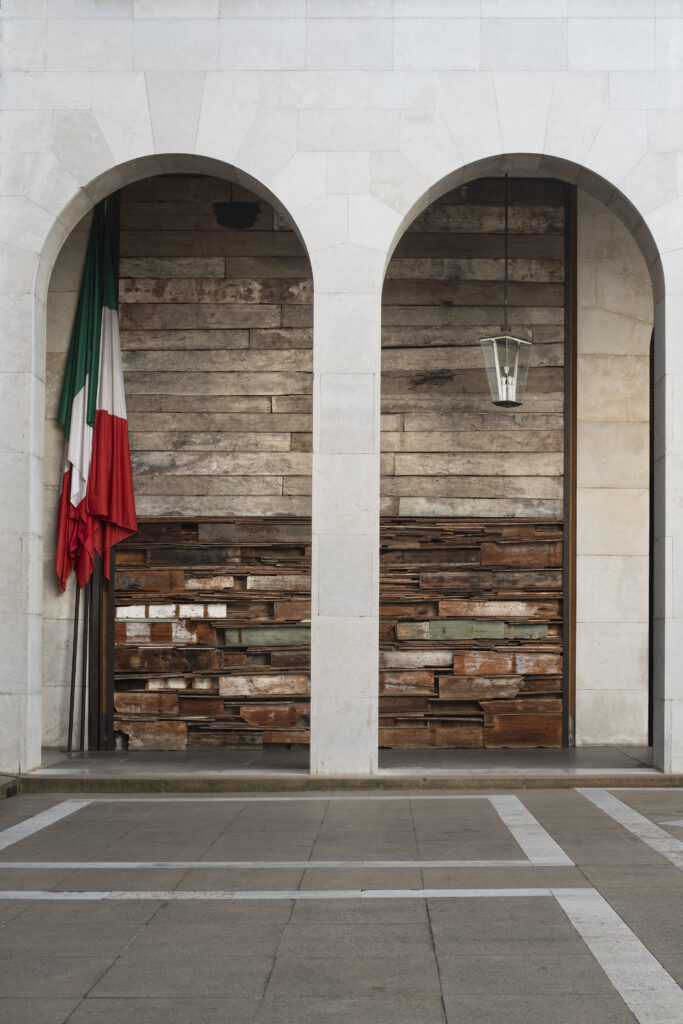
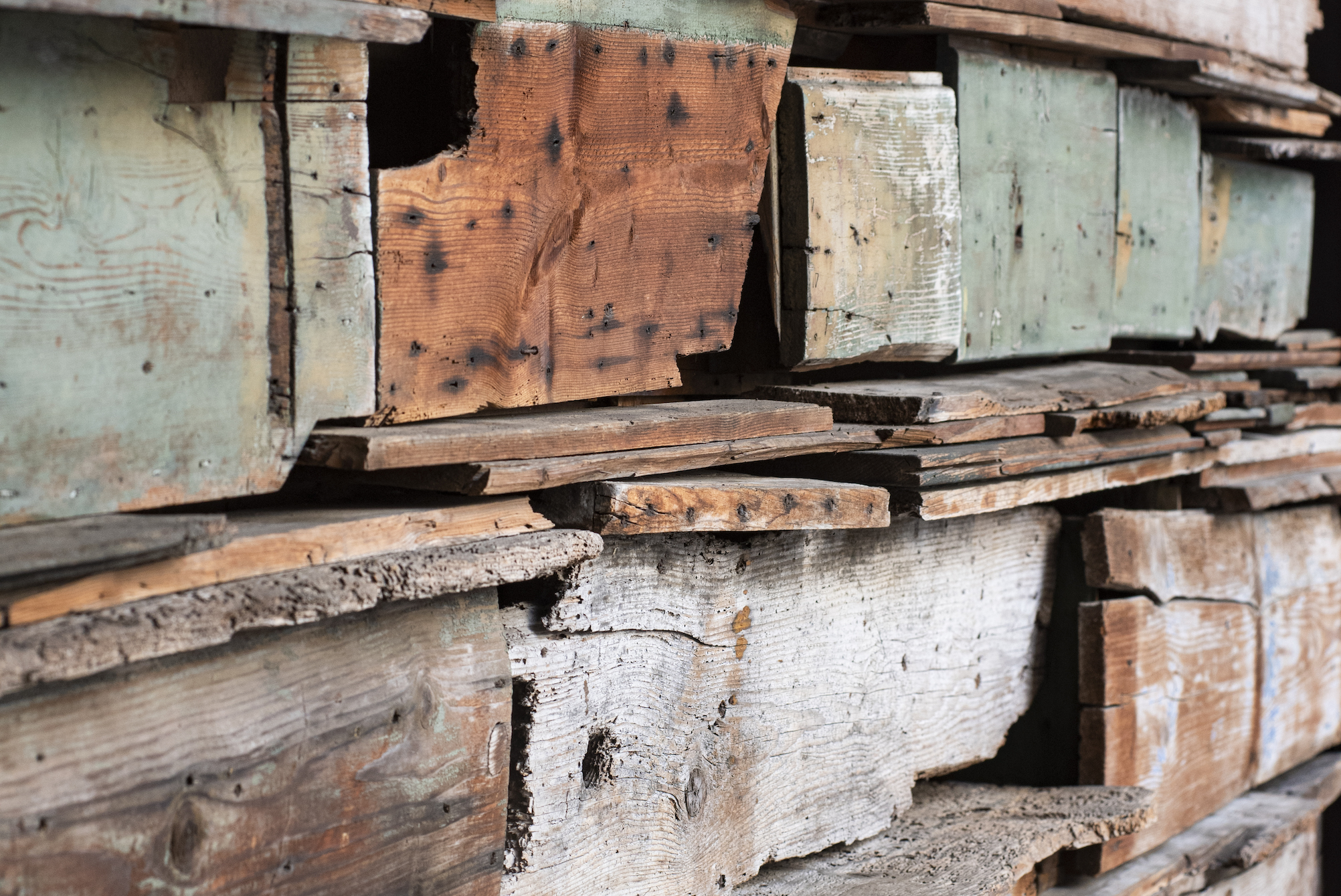
“This very sober wall of fragments, built upon two elements in dialogue, as in the majority of Jannis’s works, a structure and a sensitivity. The old, weathered wooden boards, almost monochrome, gathered from around the city, always in abundance, scattered across the floor. With a careful eye and slow gestures, he would choose them one by one and ask his assistant, Damiano Urbani, to place them one on top of the other like embroidery, without focusing on aesthetics or pleasant colors that might briefly catch the eye. After a meticulous construction, he would let it rise freely and lightly to the ceiling of the portico.”
“The wooden fragments have a date and a history: the first time was in Berlin, in the windows of the Martin Gropius Bau palace, overlooking the Gestapo bunker, which at the time was still filled with debris. Later, they also appeared in the theater with Carlo Quartucci and on other occasions.”
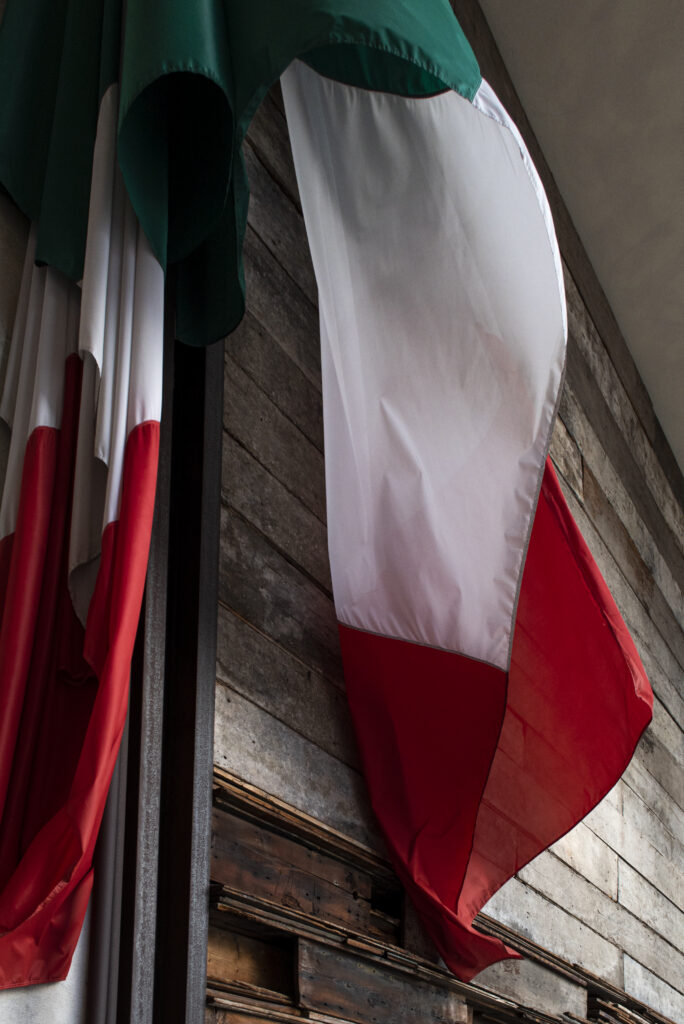
And finally: “The three flags that close the side panels, without rhetoric, hanging down gently at the corner, not waving but with a simple gesture, as if they were splashes of color, as if they were flowers. I believe the flags, like the flowers he used in certain works and on stage, also carry here a meaning of noble mourning. He wanted to remain extremely sober, always keeping in mind the solemn occasion for which he was working, and showing the greatest respect for the three professors to whom this ‘fresco’ was dedicated. He never deviated from this principle, and whenever he took part in a commemoration, he approached it with great delicacy. He did so for the painter Mario Mafai, who had been his teacher and for whom he was asked to contribute to an exhibition. He made a simple gesture: he mounted a series of his iron sheets on the wall, with bare shelves on which Mafai’s paintings were simply placed side by side—as if gently holding him in his arms, nothing more. Mafai used to say that his was a generation of the ‘post-post-war,’ and Jannis shared that spirit. This is why his fragment necessarily emerges after a tragedy, but carries a positive mission: he was in love with the fragment, which in a single moment restores the flavor of a lost unity and preserves, like a seed, the principles of reconstruction.”