There are places of worship that do not wait to lose their function before becoming spaces for contemporary art. One such example is the Church of San Fedele in Milan, which has embraced contemporary art for decades and, a few years ago, also gave rise to the San Fedele Museum.
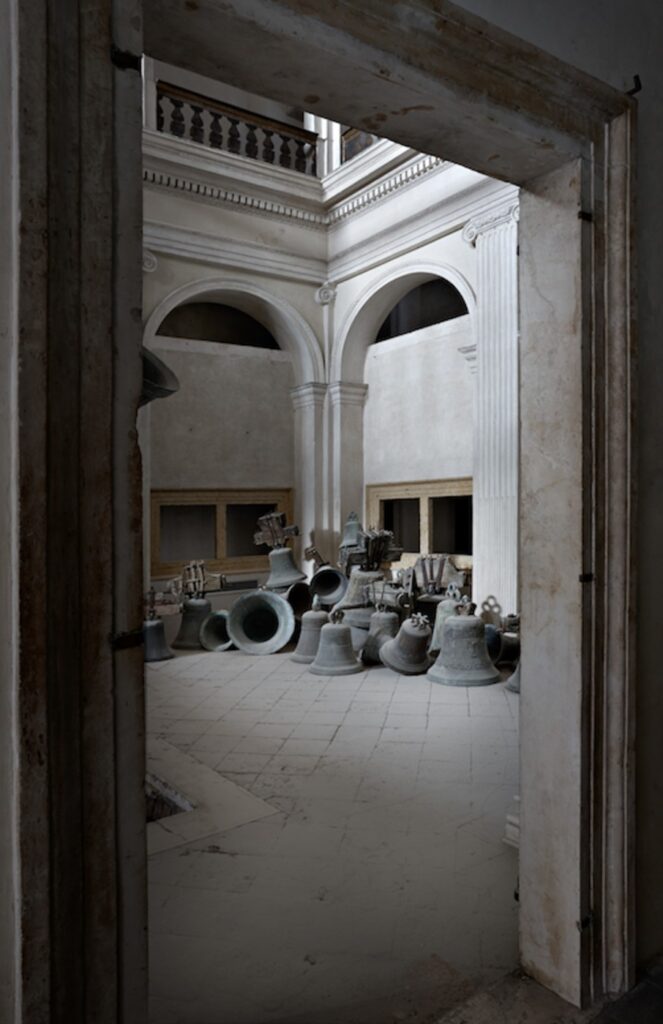
There are also cases in which ecclesiastical spaces lose their original function but remain under the management of Church-related organizations and become arenas for dialogue with contemporary art. This is the case of the former Oratory of San Lupo in Bergamo, a fascinating two-level space built in the 18th century by architect Ferdinando Caccia for the youthful Confraternity of Death. It is managed by the Adriano Bernareggi Foundation, an instrument of the Diocese of Bergamo, and is described as “particularly attentive to the specific reasons that Christian culture seeks to share with anyone who seriously searches for the meaning of things.”
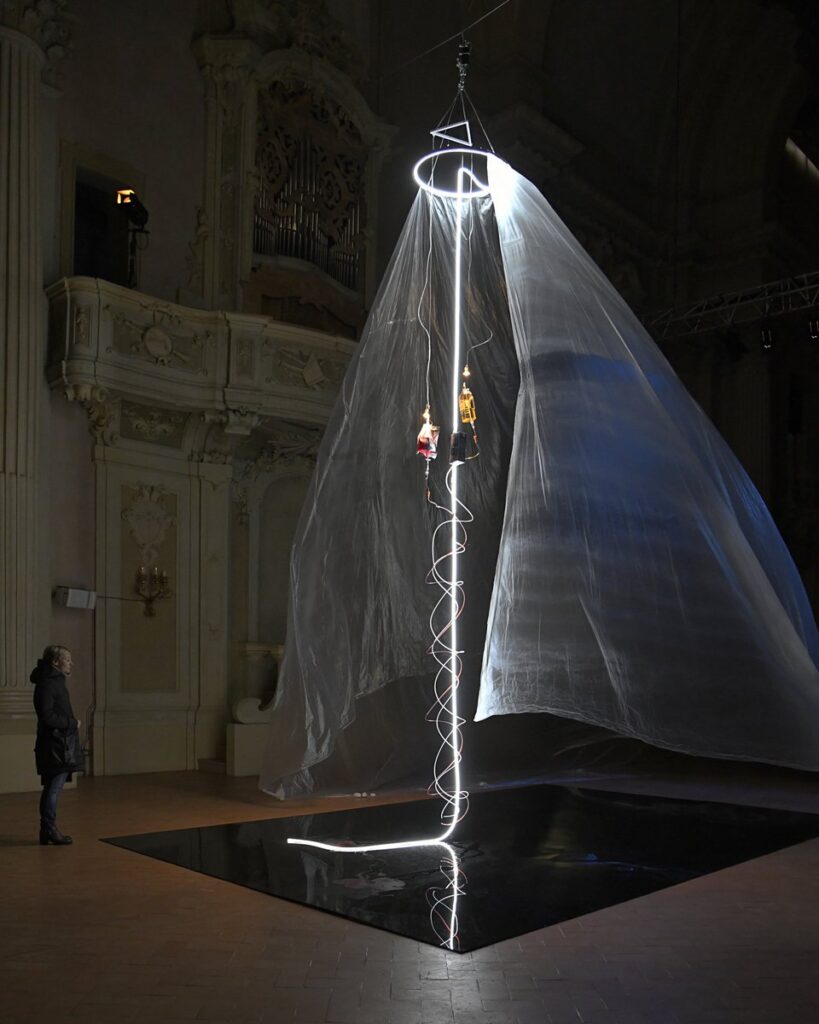
Since 2007, the foundation’s scientific director, Don Giuliano Zanchi, has brought to life a program of high-level exhibitions in the former oratory, hosting over the years works by artists such as Jannis Kounellis, Vincenzo Castella, Andrea Mastrovito, Getulio Alviani, Giovanni Frangi, and Claudio Parmiggiani.
In the latter case, the choice fell on an artist who often engages with the religious dimension consider, for example, his creation of the main altar in the Cathedral of Reggio Emilia—and who is known for his Delocations, works made with dust, fire, and smoke, crafted in a light, allusive, and evocative manner.
In Parmiggiani’s work, the approach to the sacred has to do with nostalgia, with something powerful that once was, and that humanity has since lost.
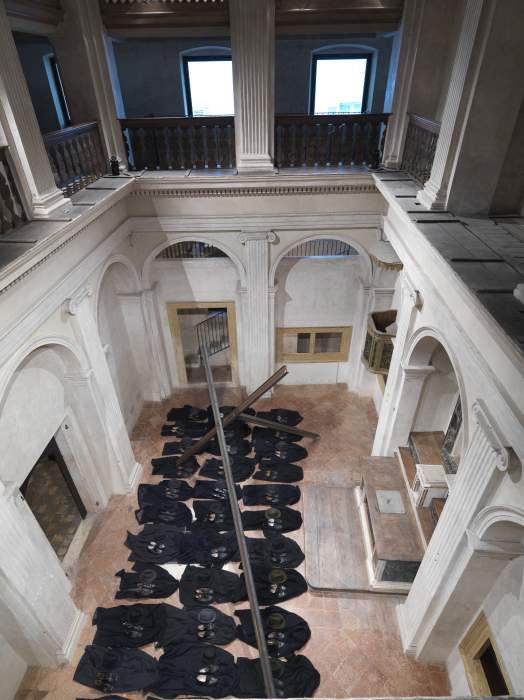
In the case of Kounellis, by contrast, the materials are heavy and visually imposing. In a 2009 installation at the Oratory, the artist, then still living, chose to display old garments laid out on the floor of the large rectangular hall. These were the mortal remains, so to speak, of people who were no longer alive. The clothes were nearly all identical, underscoring how death unites everyone and erases all differences.
The space of San Lupo had long been used as an ossuary, and this somewhat macabre aspect provided the Greek-born artist with the perfect inspiration. The installation was further enhanced by an enormous, heavy cross made of rusted metal, looming above the rest and giving the entire scene an unmistakably religious dimension.
It was a kind of one-act performance, powerful and theatrically expressive, with a striking emotional and communicative force.
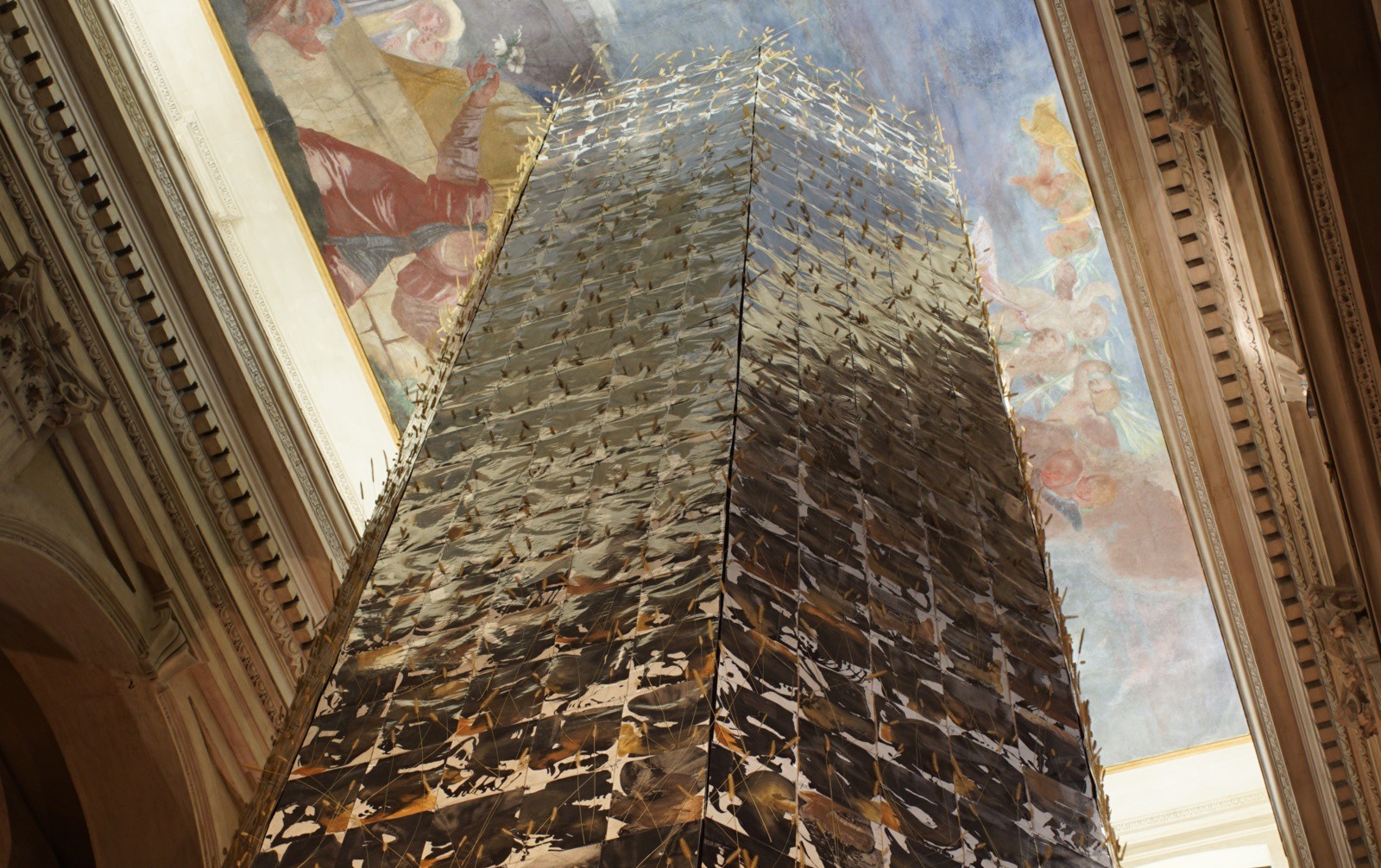
One of the most recent installations, in 2019, was created by Maurizio Mazzoleni, who positioned a vertical monolithic octagonal prism, just over twelve meters tall, as an archetype of the Tower of Babel. He built his tower brick by brick, sign by sign, layering it with memory, experiences, emotions, and the unconscious.
The eerie and distinctive appeal of the Oratory of San Lupo reveals a strong inclination toward the desire to recreate spaces for virtuous and even selfless dialogue between Christian culture and the most compelling expressions of contemporary culture.
Don Zanchi says: “I believe that this kind of attitude is not simply a gesture of goodwill. On the contrary, it belongs precisely to the specific nature of an evangelical culture, perpetually driven by a passion for humanity, capable of listening to its voice, sensitivity, aesthetics, and culture. This is a work that Christianity has carried out throughout all ages.”
A space for dialogue, then, but also for research and experimentation, bringing together souls that sometimes seem irreconcilable, giving a new role to religious places.