The postponement of the Cortina Ski World Championships from 2021 to 2022 has been requested. Cortina will also host the 2026 Winter Olympics.
In these places, there are some notable cultural projects that aim to leverage the context to create a virtuous circle of value creation and visibility.
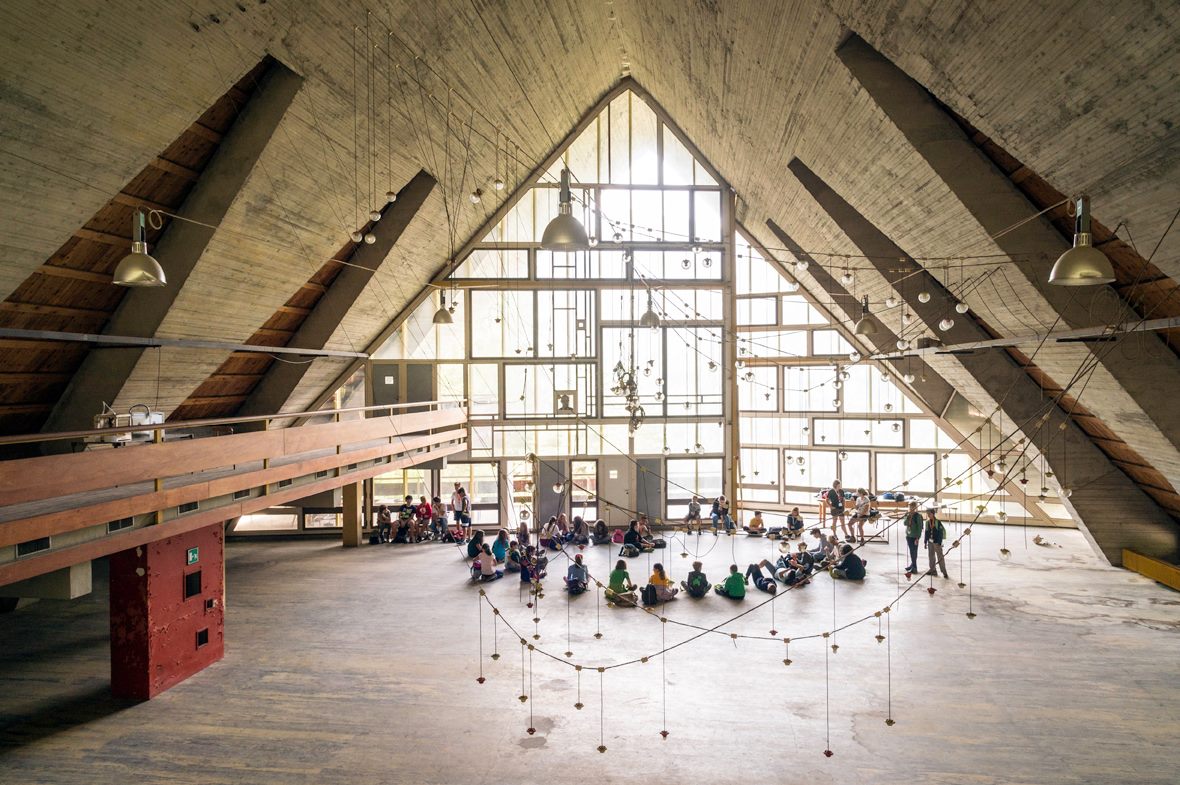
Among these, we want to tell you about the former ENI Village in Borca di Cadore and a church within the complex that is expected to become the cornerstone and symbol of a reuse opportunity that has already been initiated in its main outlines.
Dolomiti Contemporanee, in fact, is a cultural project that since 2011 has aimed at
enhancing sites with high potential within the UNESCO Dolomites World Heritage area. Progettoborca, an active regeneration initiative since 2014, is a complex project focused on the redevelopment of the former ENI Village in Borca di Cadore, with the goal of repurposing some of its parts.
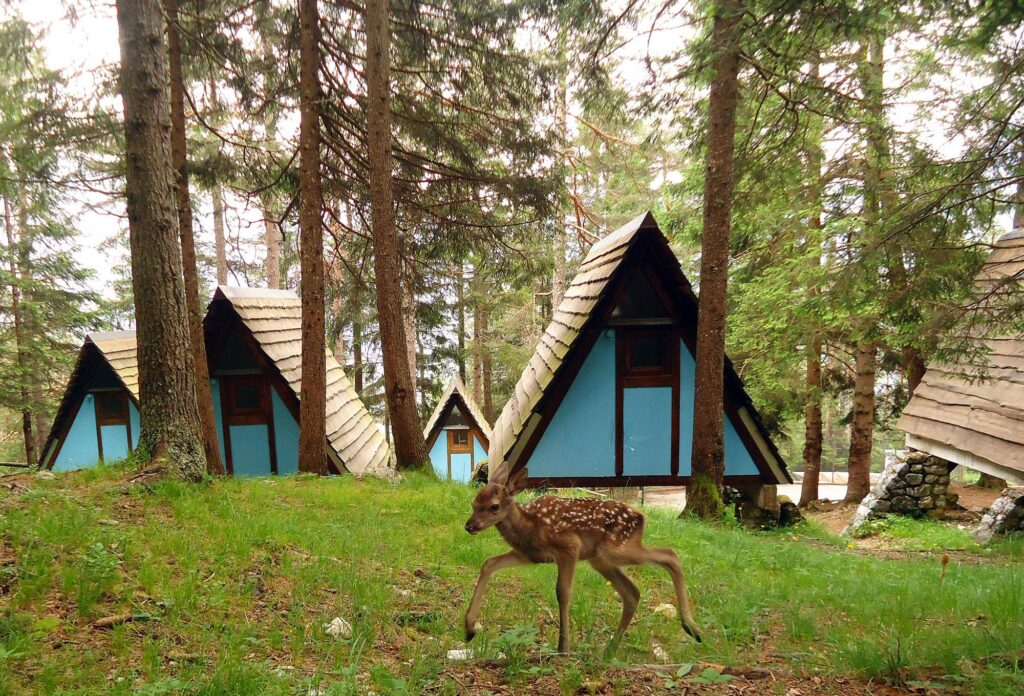
The former ENI Village is the result of an ambitious vision by Enrico Mattei, built between the 1950s and 1960s by architect Edoardo Gellner, with the collaboration of Carlo Scarpa, and served as a holiday colony for ENI employees. Mattei believed that a company’s greatest asset is its employees, who must be placed at the center.
Hence, the creation of housing for staff near the company’s industrial complexes and the development of villages for holidays and leisure for their children and families.
The village covered an area of about 200 hectares, with plans to accommodate 600 children and 263 villas. The site has always attracted great interest not only from the worlds of architecture and sociology but beyond. The history of the Church of Nostra Signora del Cadore, located within the village, is rich with anecdotes.
Mattei was a man of faith and saw the church as the central place around which the village population would gather. From this idea, the church’s role gradually grew, becoming, after its construction, the heart of the entire village urbanistically, architecturally, and symbolically.
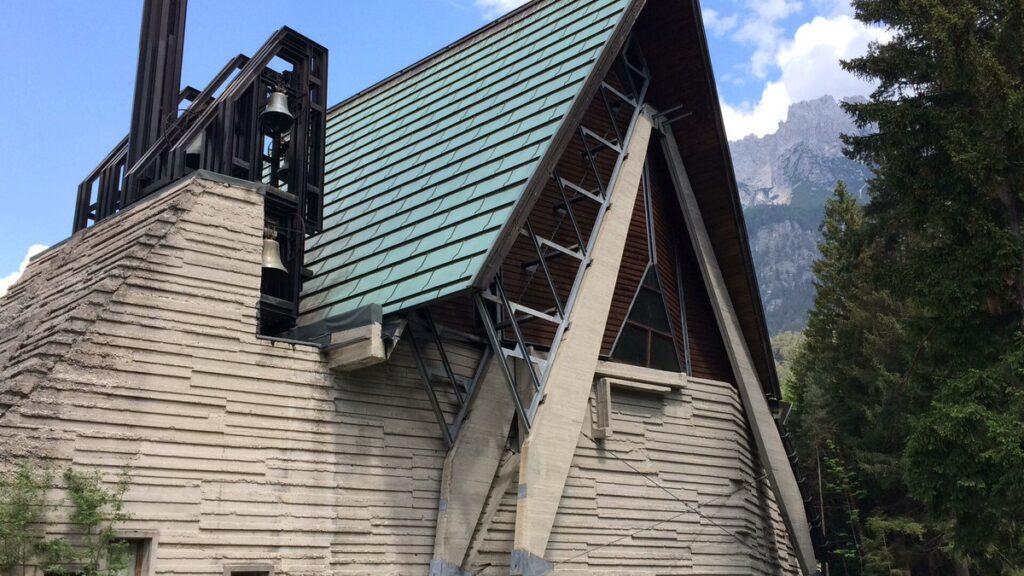
When in 1956 Gellner asked Carlo Scarpa to collaborate on the village church project, the complex was already in an advanced stage of design, as were many of the houses, and the church project had already been defined.
Certainly, convincing the already established Scarpa to collaborate on a project largely already outlined was probably not easy, just as trying to reconcile the master’s vision with the unprecedented setting, the forest and the mountain, was challenging. Yet the result proved to be a perfect synthesis of the two talents coming together.
The church has a distinctive shape, featuring a large open space defined by columns that support pairs of ribs upon which rest the two large roof slopes, inclined at 60°. The organic and angular forms create a profound connection between the architecture and the mountain, while the spire—an impressive 55 meters tall—allows the building to assume a prominent role in the landscape, framed by the deep valley and the peak of Antelao.
Mattei’s death in 1962 diminished the momentum necessary to realize this social utopia experiment fully, so the project was only partially completed compared to the original plan. Nevertheless, it remains an exceptional and unique site in Italy, where the strong aspects of landscape and natural environment blend excellently with the organic architecture.
One of the challenges for maintenance and enhancement concerns managing the forest, which tends to encroach on the buildings, and the other involves restoring the overall significance of the site.
An example of the village’s redevelopment project, under Progettoborca, is linked to an international artist residency initiative that is already underway.
Artists are invited to live and work in these places, including the church, and to leave a mark of their work, always with a spirit of sharing and collaboration, in keeping with the founder’s vision.
Dolomiti Contemporanee has devised a medium- to long-term program for the area, aiming at a “refunctionalization that goes beyond merely generating a restart impulse, instead committing to the cultural and identity redefinition of these dormant assets, whose full potential is intended to be rehabilitated in an innovative way, yet consistent with their significant historical background.”
In other words, it’s not just about revaluing an architectural site and a church, but also about social values and innovation.