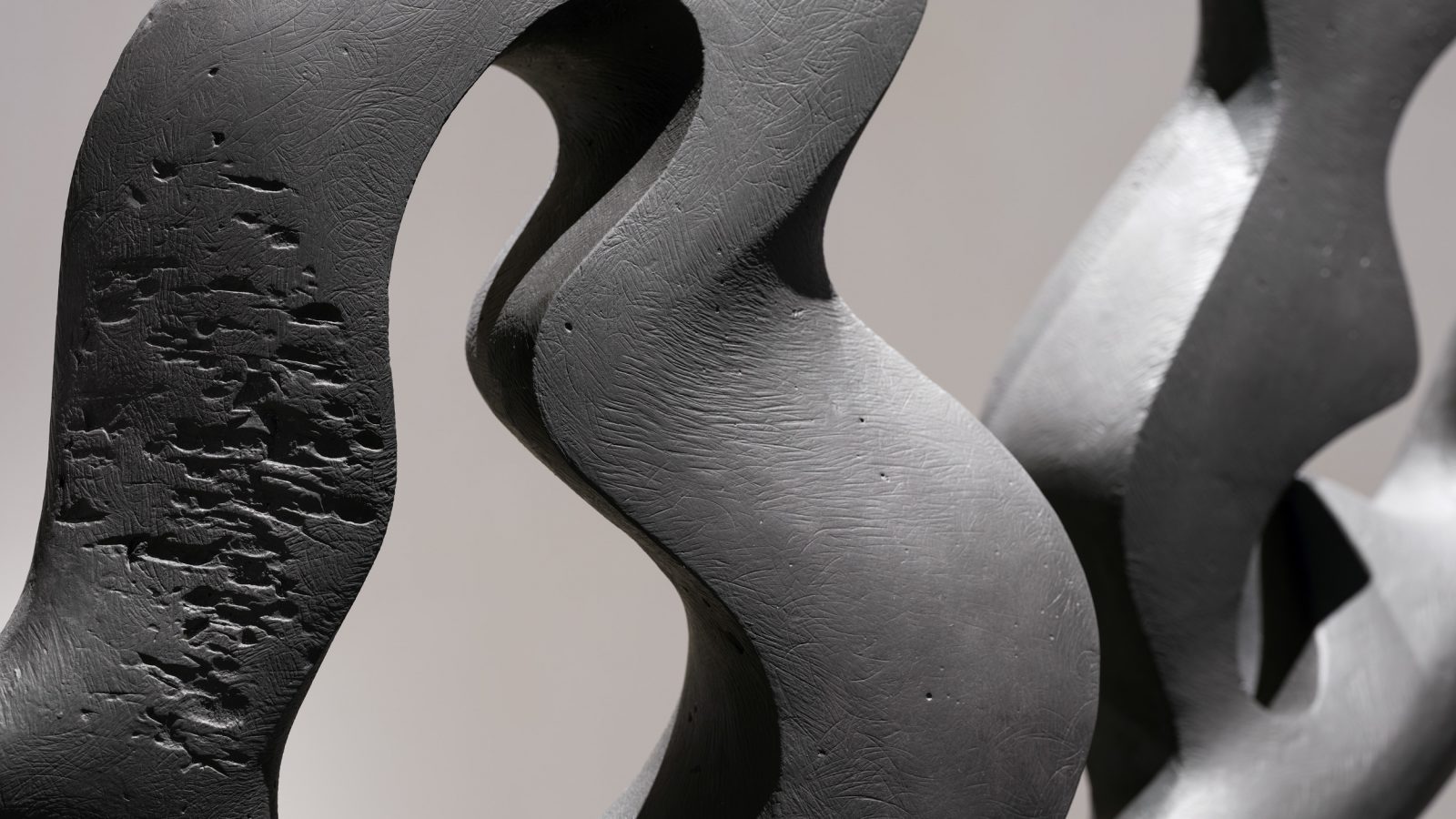
The following article is based on the text by Sileno Salvagnini Bruno De Toffoli and Venetian Art Criticism in the Postwar Period*, which aims to retrace the historical and artistic context of the 1950s and 1960s, during which Venetian Spatialism developed and from which the figure of Bruno De Toffoli emerges.
In 1952, the sculptor De Toffoli responded to a letter published in the “Gazzettino – Sera” regarding an article by Guido Perocco, who had described him as a pupil of Alberto Viani. De Toffoli denied this claim, clarifying that, while he appreciated certain modern artistic movements, his true masters were sculptors such as Arp and Brancusi, and not the aforementioned Viani. The letter reveals a certain acrimony towards Perocco despite the critic having praised De Toffoli in the past, suggesting his participation in the Venice Biennale.
Starting from his production in the 1940s, during his studies at the Venice Academy, it is noticeable that De Toffoli’s sculptures bear the influence of Arturo Martini, while exploring a more spatial approach; for example, works like Composizione from 1949 demonstrate his interest in sculpture merging with space. His stylistic evolution, distancing itself from the sculptural traditions of the period, could explain his desire to break away from Viani, who was highly regarded at the time.
His career at the Academy marked a significant change in De Toffoli’s artistic path, with an improvement in his style and the influence of new masters, such as Venanzo Crocetti. This is confirmed by the sculptor’s diploma, which reveals a rejection of the period when he worked with Martini and Viani, preferring more modern references like Alexander Archipenko.


In 1954, De Toffoli’s sculpture Eternità della macchina was exhibited at Carlo Cardazzo’s Galleria del Cavallino in Venice, and for the first time at the Biennale that same year, alongside other works such as Azione delle verticali and Attimo nello spazio. Although all were made of plaster, these sculptures were placed in the Biennale’s garden, a decision justified by the lack of indoor spaces and the perception that the works of a young artist could be ‘sacrificed’ outdoors. This approach highlighted a certain difference between De Toffoli and more established sculptors like Viani, whose works were instead displayed inside the Biennale halls. The choice to exhibit De Toffoli’s fragile plaster sculptures outdoors sparked discussions about potential damage to the material, as noted by Roberto Longhi and Rodolfo Pallucchini (members of the Biennale’s Subcommission for the Visual Arts).
De Toffoli’s works evoked a mixture of unease and curiosity, radically distancing themselves from traditional sculpture and the artistic choices of his contemporaries. For example, works such as Attimo nello spazio and Eternità della macchina feature unusual and provocative forms, far removed from any previous iconographic reference, with structures that seem to challenge the conventions of modern sculpture. Although innovative, these pieces were initially underestimated compared to more established artists.
The second half of the 1950s marked a period of great ferment for contemporary art in Italy: in 1958, the artist participated again in the Venice Biennale, and this time his works, such as Metamorfosi, Genesi, and Evento spaziale, were presented by Giampiero Giani, one of Italy’s leading theorists of this movement and author of numerous manifestos. Giani recognized the potential in De Toffoli’s rejection of conformity to the sculpture of the time, and praised the originality of his formal and spatial research, in which light and void become essential elements.
In the same years, the magazine Evento was published, founded in Venice in 1956, which became both a medium and a reference point for the spatialist movement. This magazine served as a critical forum for art and culture, with contributions from intellectuals such as Toniato, Rosada, and Ballo, who advocated for a vision of art not as mere representation, but as a dynamic synthesis of space, light, and form.
Toniato, in particular, in his writings on De Toffoli, explored the notion of sculpture as a fusion of fullness and emptiness, emphasizing the autonomy of the artwork which was no longer merely a static object but an event in continuous evolution. The concept of “freedom” in De Toffoli’s sculptures does not imply randomness or abstraction, but structural freedom that transcends stylistic conventions.


The period, if it can be called that, of De Toffoli’s artistic production after his participation in the 1958 Biennale began to evolve; the sculptor’s attendance at various exhibitions became increasingly rare due to his growing teaching commitments at the Venice Art High School. Nevertheless, it remains clear that the spatialist experience was fundamental for De Toffoli, re-emerging in subsequent decades in new forms: drawings and depictions transformed into ‘an idea of a technological city.’ De Toffoli’s spatialism was a phase capable of bringing about a transformation in the field of sculpture.
* S. Salvagnini, Bruno De Toffoli and Venetian art criticism in the postwar period, in “Bruno De Toffoli. The Spatialist Adventure,” Fondazione Alberto Peruzzo, Padua, 2025.