I am Salvatore Iaconesi, an artist, and together with my wife Oriana Persico, we coordinate a network of artists, designers, anthropologists, and researchers called Art is Open Source, as well as a research center named HER: She Loves Data. We use art and design to understand the role of technology in our society, a role that is fundamental to how society itself evolves.
Those who know me are aware of how important it is, in my view, to consider illness as a way to understand society. In contributing to this initiative by Fondazione Alberto Peruzzo, from our perspective, we cannot overlook the moment we are living through.
In 2012, I was diagnosed with brain cancer, and it was precisely technology, especially ubiquitous technologies and those related to data that helped me reposition illness as something central to society and culture, rather than something that affects only the individual.
As this pandemic spread, something particular happened: unfortunately, I became ill with cancer again. I’m doing well now, but it was an opportunity to observe phenomena concerning both myself and the world in relation to illness. Once again, data played a fundamental role not only to understand this coexistence and clash between my individual reality and the global reality. Primarily because healthcare was and still is largely absorbed by the fight against coronavirus, and, for example, the hospital had difficulty releasing data that concerned only me and my condition.
In this hyper-technological and interconnected world, data allow us to better understand how things are going not for their content, as McLuhan said, but as a social phenomenon, and therefore also connected to culture and psychology, for instance.
I’d like to propose a journey through three of our artworks created with data, all on the theme of the positioning of data in our society, to better understand what we have just discussed.
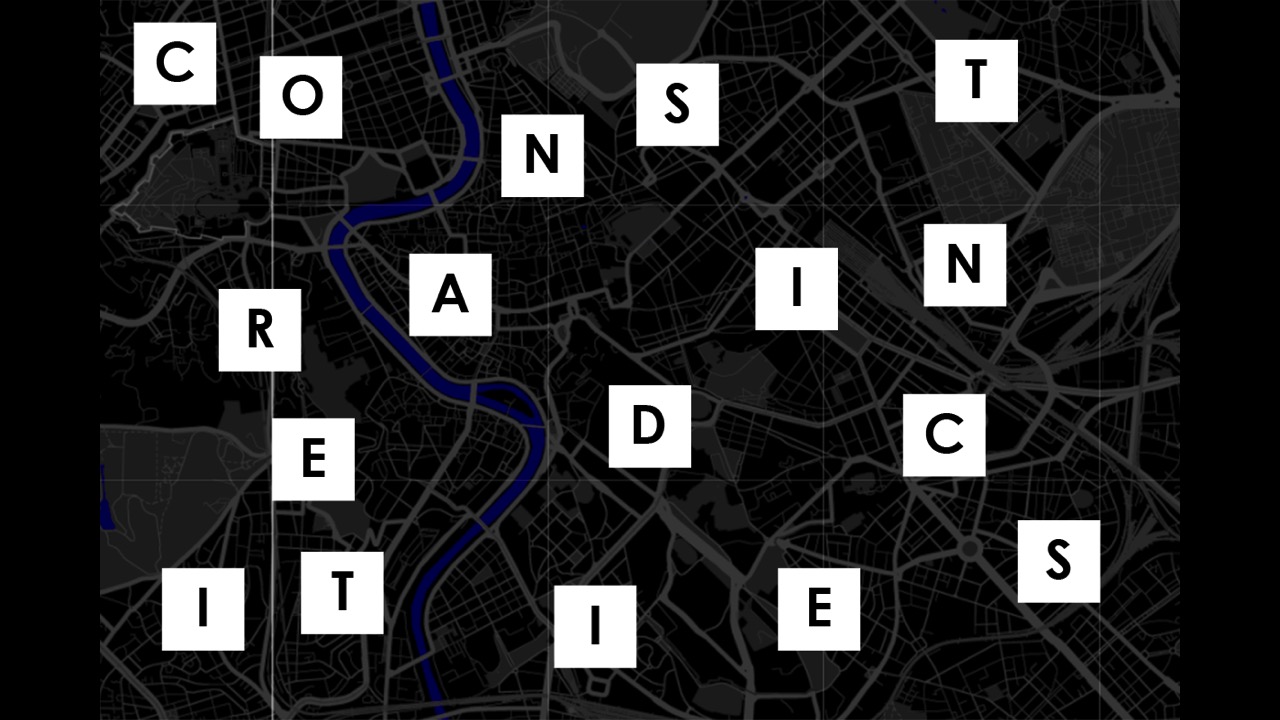
The first of these works is Constrained Cities, a wearable piece. It explores how artificial intelligences, by collecting lots of data about us, form an idea of which areas of the city are most suitable for us; for example, if we earn a lot, a wealthier neighborhood might suit us better, or if my girlfriend lives in a certain place, maybe that’s the best area for me. Artificial intelligences can decide for each person which is the best area of the city, and the artwork takes this to the extreme: a wearable band emits shocks if I move away from my most suitable zones. It tries to redirect you where it’s better for you. If two people in the same place have different responses, shock and no shock, they might ask what is different between them.
Thus, data and their computation allow us to move beyond the technical domain and enter the existential one; this is a crucial transition in our society. In the case of Constrained Cities, this even happens through a small suffering, the artificial intelligence causes me some pain to deliver a message.
Another artwork we created, titled Baotaz, explores the realm of possibility. Baotaz is a wearable helmet—we like the idea that artificial intelligence can be wearable—and it creates an augmented sense. This sense is connected to enormous amounts of data. For example, what would a sense linked to climate change feel like, through vibrations, heat, or something similar? Today, the only way we have to experience global phenomena—climate change, but also poverty, and even the spread of coronavirus—is through massive amounts of data. But we are limited human beings and struggle to engage with such huge quantities of information. The challenge is to understand how to gain an added sense—this helmet—that helps us better comprehend that data, and thus the world we live in.
Another important work for us is Stakhanov—named after the Russian miner. We jokingly call this piece the Big Data God because it works like an oracle. When you bring it somewhere, it starts gathering information and data about that place—from social networks and open data, for example—in a decisive way, and begins making predictions, just like an oracle would. Once it has accumulated enough data and produced a forecast, it prints it out on long rolls of paper. After a while, you can have hundreds of meters of printed paper, and people usually compete to read something about their future.
Looking above the artwork, you can notice four flags, each bearing an element of a new cosmogony, which is an important part of our lives to position ourselves individually in this universe, which today is also made of technologies, data, artificial intelligences, digital assistants, etc., all having a tangible impact on how we live, for example when they give us a promotion or increase an insurance premium.
I want to close with this thought: we have a deep need to build new cosmogonies and new rituals to inhabit the planet we find ourselves on, and this will be fundamental for the evolution of our civilization.
Biography
SALVATORE IACONESI | He is an artist, designer, and robotic engineer. He was a skater and a raver, and all these practices, both inside and outside technology, share Salvatore’s main passion: exploring the degrees of freedom of human beings in the contemporary world. In 2002, Salvatore was diagnosed with brain cancer. In 2012, he decided to leave the hospital to start La Cura, a global performance to reclaim one’s own body and identity by creating an open-source participatory cancer cure.
ORIANA PERSICO | She is a communication scientist, writer, and cyberecologist. She joined Art is Open Source in 2007.
“HER: She Loves Data” is a next-generation cultural research center founded by Salvatore Iaconesi and Oriana Persico. It uses data and computation (complex algorithms, artificial intelligence, networks, ecosystems) to create processes of cultural acceleration through art, design, and the results of scientific research and technological innovation.
Art is Open Source is a network of artists, designers, anthropologists, and researchers.