Nestled in the hills of the Piedmont Langhe region are some of the most significant works by one of contemporary art’s masters. It is precisely in these splendid hilly landscapes, the homeland of fine wine, that the English artist David Tremlett has created permanent site-specific works featuring different color tones and geometric shapes.
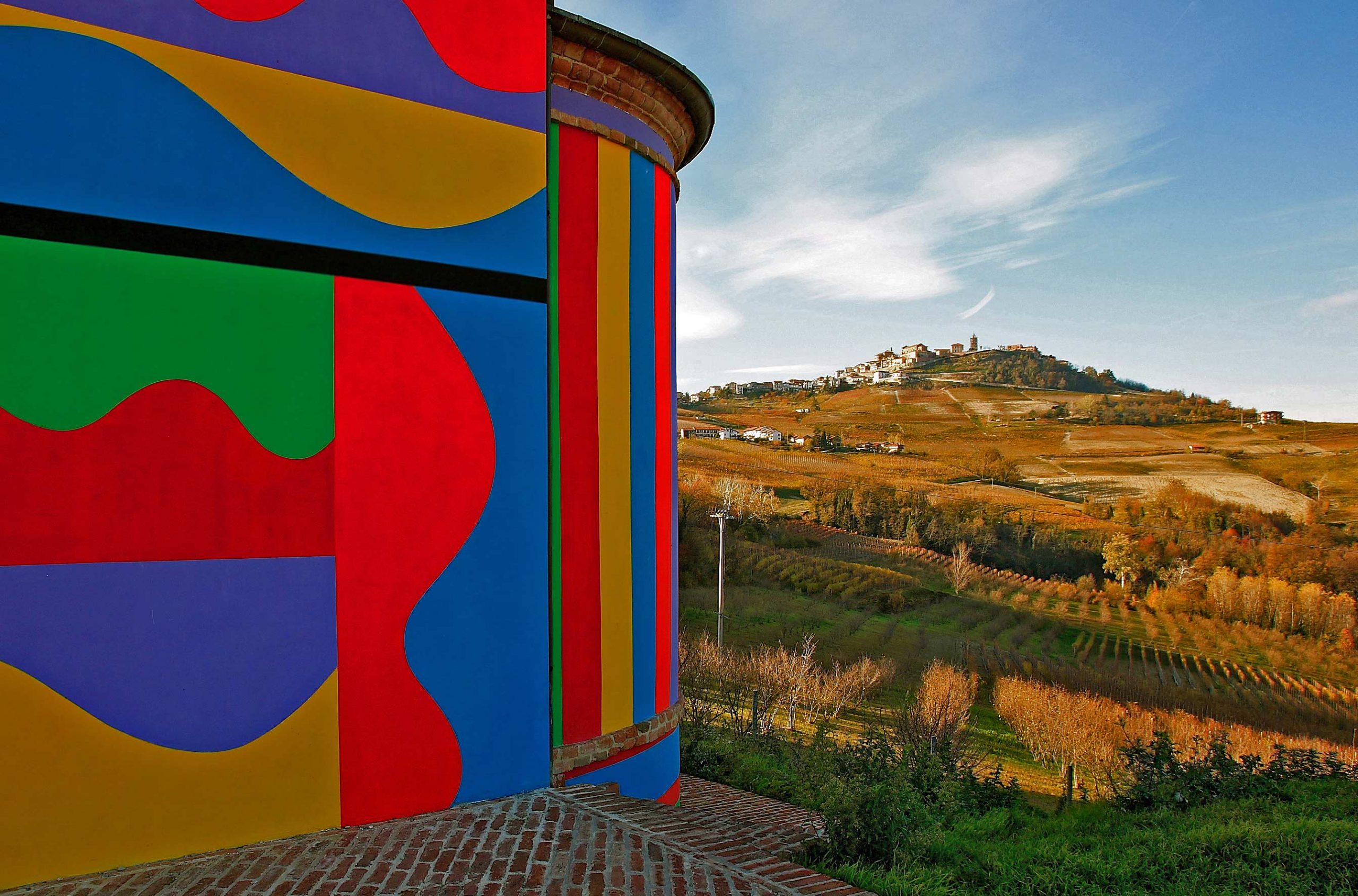
The Chapel of the Most Holy Madonna of Grace in La Morra, also known as the Barolo Chapel, is undoubtedly one of the artist’s best-known projects, centered on the recovery and enhancement of the surrounding territory.
Built in 1914 as a shelter for farmers from bad weather and to store agricultural tools, the chapel was never consecrated. After years of abandonment, it became one of the most famous buildings in the Langhe thanks to the Ceretto family, who in 1999 commissioned conceptual artists Sol LeWitt and David Tremlett to restore it. The result is a perfect blend between the evocative landscape of hills and vineyards and the artists’ creativity: vivid, colorful exterior walls by Sol LeWitt, and softer, serene tones inside, crafted by Tremlett.
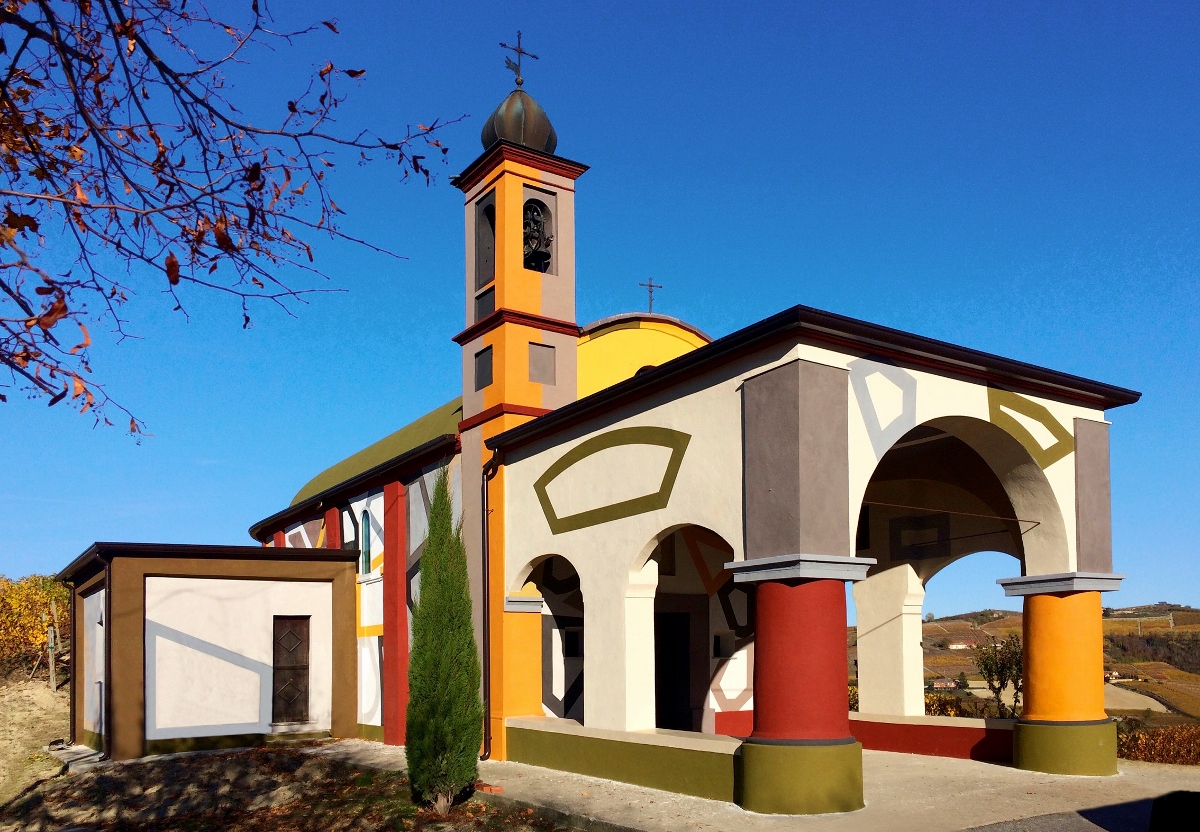
A few years after the Chapel in La Morra, the artist was involved in the restoration of the Church of the Blessed Virgin of Mount Carmel in Coazzolo, in the province of Asti, built at the end of the 17th century. The building, covering over 300 square meters, is set in the stunning landscape of the Moscato hills. The artist’s distinctive technique divides the surface into three zones, each dominated by a color that reflects the tones of the surrounding environment.
Also in the Piedmont region, in Santo Stefano Belbo, in the province of Cuneo, he frescoed the deconsecrated chapel of the former Cistercian complex of San Maurizio; now a five-star hotel belonging to the Relais & Châteaux chain. The restoration, which celebrates the monastery’s 400th anniversary, was carried out with full respect for the site. The interior walls are frescoed with color gradations and geometric shapes that blend with those of the chapel and express the relationship between sign and architecture typical of his work.
David Tremlett himself has said that the evolution of the colors he uses comes from his love for Italy and the Langhe region:
“In Italy, I was surrounded by the frescoes of Giotto, Piero della Francesca, Mantegna […]. I was immersed in color and felt I had to change the way I draw.”
He explained:
“The first time I visited the Chapel at Relais San Maurizio, I noticed that the vault of the WHITE SPACE (the original name of the exhibition space) had no connection with its walls. Something didn’t make sense. Now, instead, the upper part of the work connects with the vault’s structure, color, and shape. The lower part of the work now forms the base, the foundation or the place on which everything rests, surrounded all around by color, light, and air. In the middle is our horizon, this is our OPEN SPACE.”
But his artistic production does not stop in northern Italy. In Tuscany, the small medieval village of Ghizzano, in the province of Pisa, is like an open-air museum. Here, the houses of its 350 inhabitants have been transformed following a symphony of colors that recall the tones of the surrounding nature “to bring the Tuscan landscape inside the street,” the artist says.
More recently, in Bari, Tremlett created a permanent wall drawing that revitalizes the historic monumental complex of Santa Chiara and San Francesco della Scarpa. The project, linked to the artist’s special relationship with the city, which he has visited 27 times, is marked by 27 large colorful elements decorating the building’s surface. It pays tribute to the city of Bari and is dedicated to the gallerist Marilena Bonomo, who passed away in 2014.