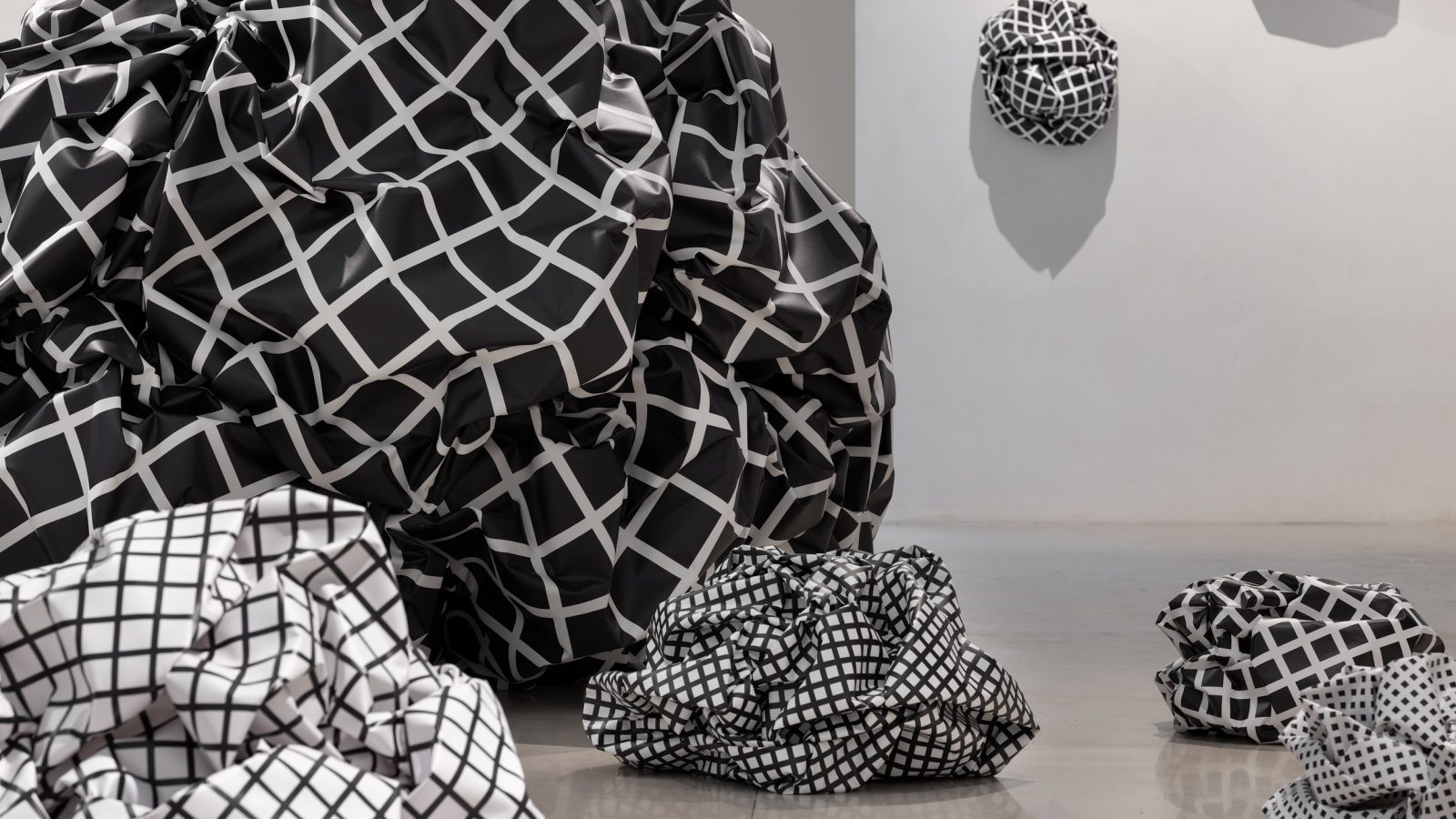
Esther Stocker’s research, since its beginnings, has employed an element that has distinguished artistic production since the mid-1920s: the grid. For Rosalind Krauss, it is an essential ingredient of the “modernist myth,” also due to its “extraordinary longevity within the specialized realm of modern art.” The ordering device based on orthogonality, most explicitly seen as a black grid on a white background, or its inversion, is what characterizes the artist’s canvases from the mid-1990s onward, a period during which she completed her studies first at the Academy of Fine Arts in Vienna, then at Brera Academy, and finally at the Art Center College of Design in Pasadena.
The grid can be conceived as a sort of zero degree of the pictorial image, a kind of background from which to start, or rather restart, once the work of deconstructing the modes of representing the ‘external’ world has been completed. There have been multiple restarts throughout the twentieth century, the longevity to which Krauss referred, but one might ask whether this is truly because the grid is a myth, if not the ultimate myth that runs through the art of the last century, or if there is something still unresolved, something concretely accessible, in that device that continues to appear even into the 2000s. Perhaps one should approach it phenomenologically, suspending judgment on all that has been practiced, seen, and written around that orthogonal background, to reconsider it in its sheer presence: a lattice of primary formal relationships given by the interaction between lines and surface, non-hierarchical, serial, neutral.
Stocker’s research, starting from this premise, employs two solutions: the first, related to the production of medium to large-sized paintings, operates within the primary system mentioned earlier, producing many variations of the same grid system by modifying the sizes of the grid’s squares and lines. She uses a limited palette of grays, in addition to the previously mentioned dyad, introducing formal alterations while never completely abandoning the principle of orthogonality. The concept of altering regularity is the disruptive element Stocker introduces into the grid system.
The lines, or rather, the relationships between parts within a given surface, do not produce just one predictable coincidence (and order, according to the observer’s expectations), but an unpredictable and unexpected misalignment of the two-dimensional geometric structure. It’s a kind of ‘programmed disorder,’ as if the system under construction had been jolted or subjected to a glitch effect, causing the line-relations to no longer coincide.
The second solution is highly consistent with the two-dimensional premise: three-dimensional space, rather than just a wall, becomes another defining element of the artist’s research, who is originally from South Tyrol. This refers to the creation of environments through complex installation works carried out primarily in museum spaces or other public venues.
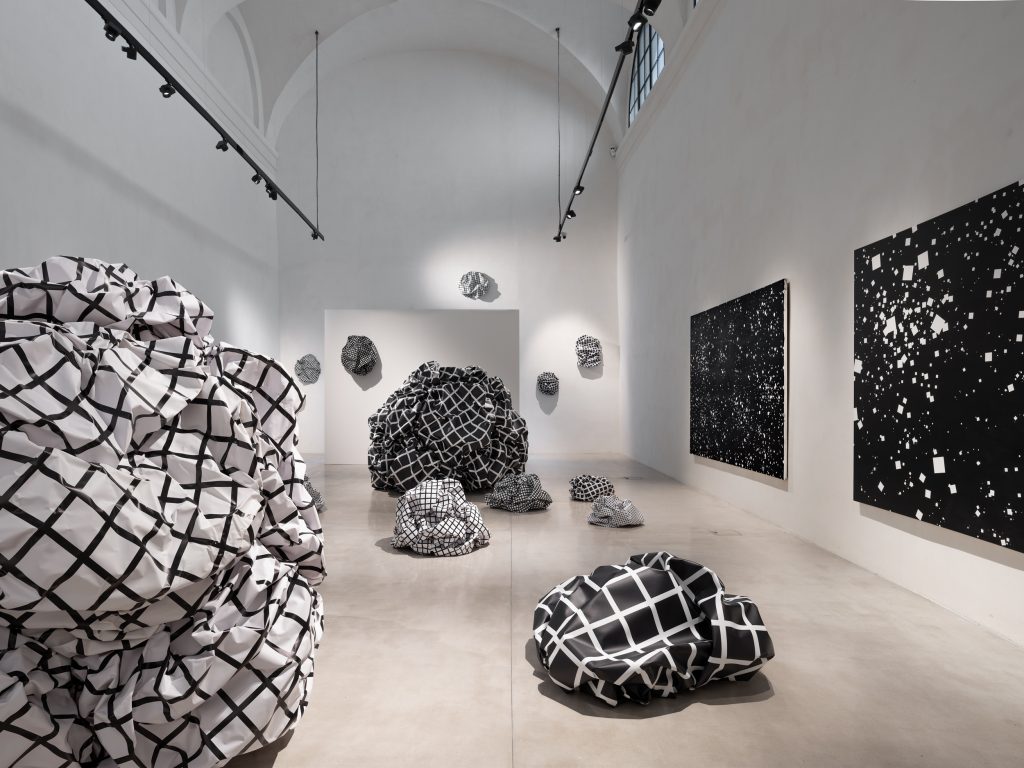
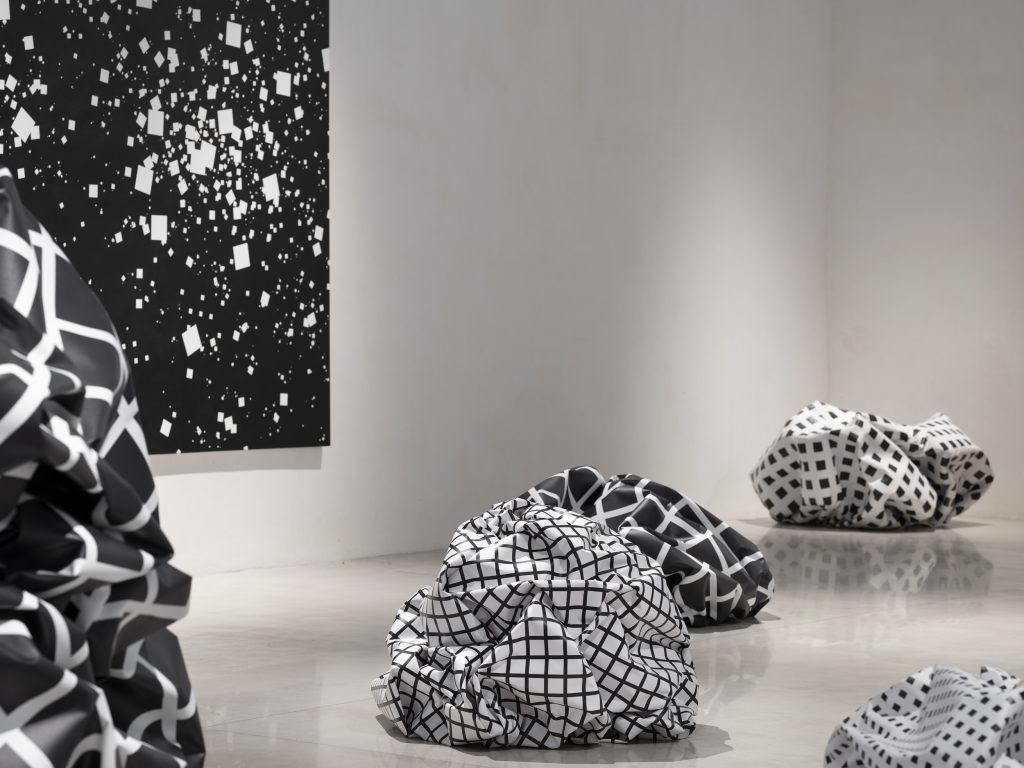
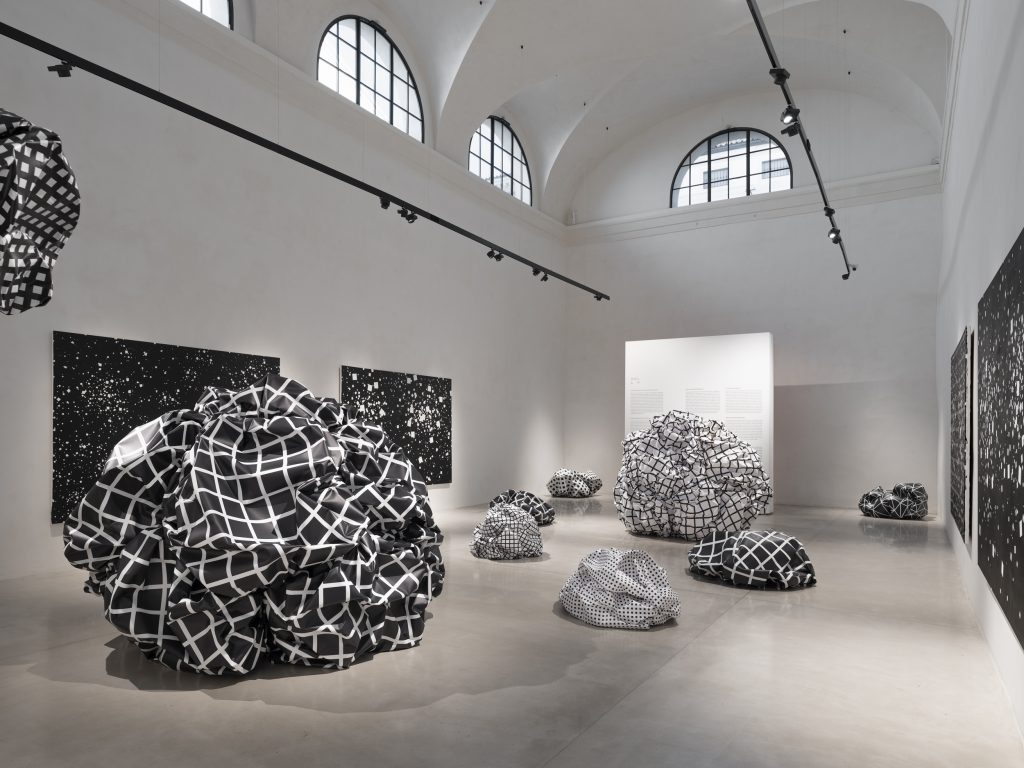
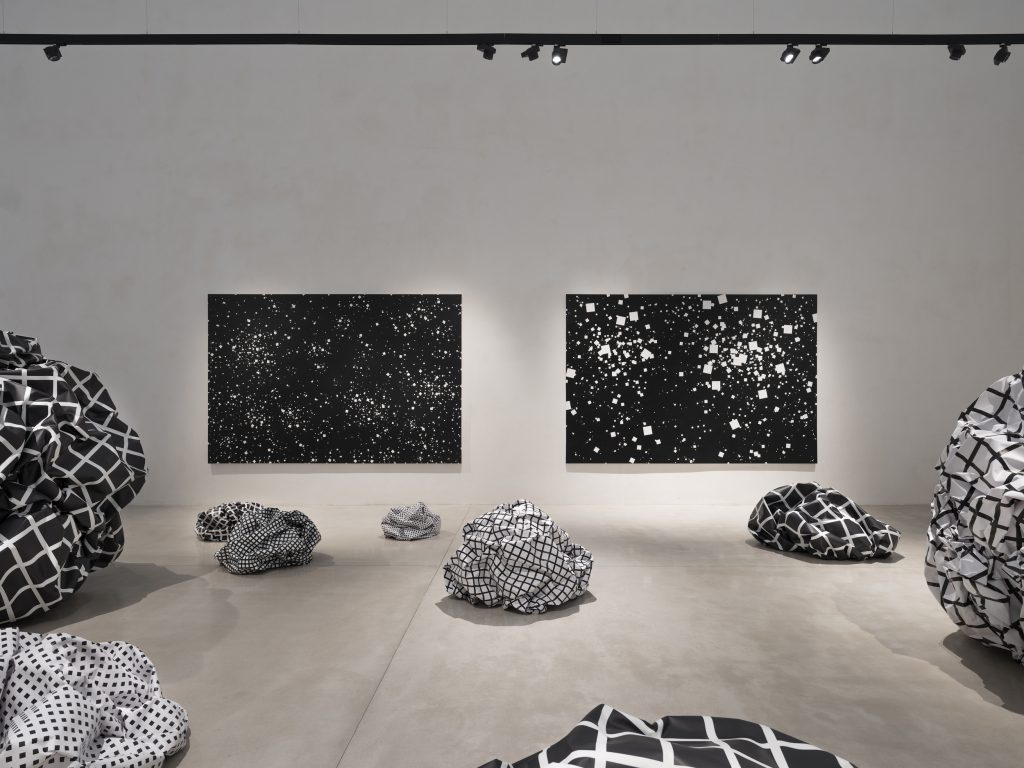
These are site-specific installations that take the characteristics and dimensions of the exhibition space as their starting point to create genuinely immersive environments. Here, the viewer wanders within a system that is, on one hand, rigorously designed and constructed, and on the other, frozen and suspended in an internal process of collapse. These site-specific interventions are conceived as “other architectures,” paradoxically made possible precisely by the functional and institutional structures originally designed by architects.
In the project proposed for the nave of the former church of Sant’Agnese, all the key elements of Stocker’s research are present, although they represent recent and very recent developments in her work that push the original premises to their limits. We find the two-dimensional treatment in the large wall-mounted paintings, using the white and black dyad, but the collapse process is pushed to the complete dispersion of the ordering device, generating a pulverization of its primary elements, reducing them to variations of square particles within a spatiality that feels unearthly, almost like a snapshot of cosmic space in evolution. It is difficult not to think, especially regarding the grid’s longevity, of the constructivist and cosmic origins of the square form.
However, it is in Stocker’s volumetric proposals, the three-dimensional concretions scattered across the nave’s floor and walls, that orthogonality undergoes a true radical process of deconstruction. These satellite-like bodies in contraction subject each geometric component, the enduring grid, the compositional principle par excellence based on regularity and repetition, to a process of dismantling, compressing, and reducing them to mere remnants. Yet, they never completely deny their original order, as if the architect had once again miscalculated the project and tossed the meticulously measured plans into an abyssal trash bin.
Thus, a scenario emerges where the conceptual virtuality of boundless space coexists
and collides with its physical concreteness. It is within this scenario that the visitor moves, surprised and disoriented, as if in a dream of paradoxical precision.