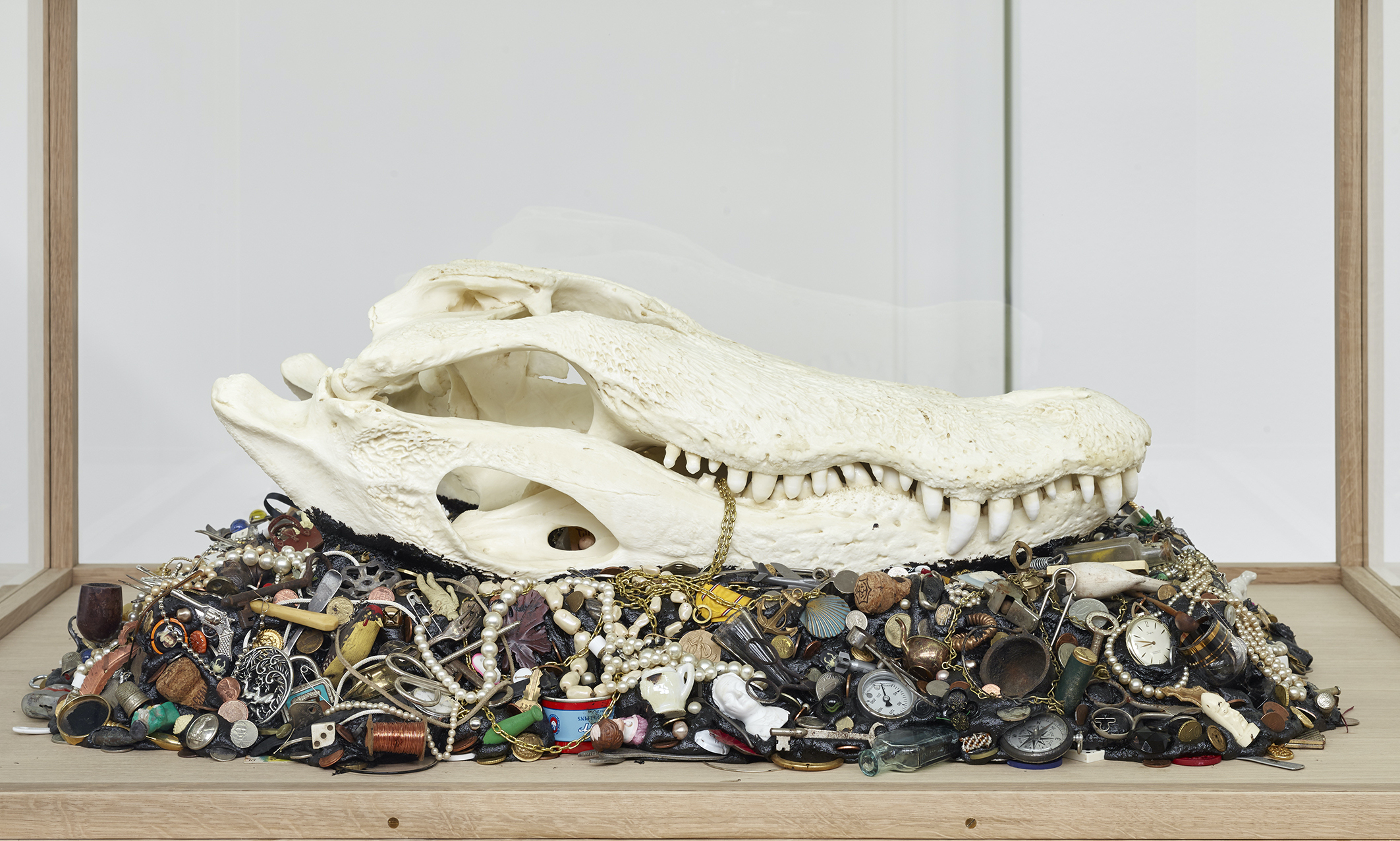
“I have had several love-at-first-sight moments; my life is constantly influenced by art. Only those who know and love it can understand how much art can change and shape a person’s choices and way of living!
So, let me introduce you to a work by Mark Dion, an artist who recently ‘struck me like lightning.’ I don’t know him personally yet, but I am discovering his work and have started a path of deeper exploration.
This piece, Alligator Mississippiensis, depicts an image filled with dark humor: the king of the swamp sitting atop a pile of kitsch objects. With his incisive archaeological approach, Mark Dion presents the largest reptile of North America — the male alligator can indeed reach incredible size and weight — giving the work the atmosphere of a natural history museum.”
Mark Dion (born 1961, New Bedford) is an American conceptual artist who combines a passion for collecting with ecology.
Through his artistic research, Dion explores the relationship between humans and their surrounding environment, questioning traditional modes of thinking and teaching.
“I identify with the mission of the museum, where one goes to acquire knowledge through objects. Museums are time capsules. They embody the values of their time,” he stated.
Recreating a sort of Wunderkammer typical of the 16th and 17th centuries, the artist transforms the exhibition space into a series of natural laboratories, museum storerooms, and mysterious hunting grounds. Like a traveling researcher, he explores new worlds and fascinates through both curiosity and fear of the unknown.
His passion for natural history collections is present in all his works. Playing the role of collector and curator of his own museums, he arranges cabinets and showcases, placing animal creatures alongside collections of natural history books, engravings, and scientific instruments. Irony and humor hold an important place in his works, which are conceived and organized with precision. His installations invite visitors to admire the diversity of nature and the methods of science, interpreted here in an artistic form.
Alongside the fascination for the beauty and abundance of nature, Dion also reveals its vulnerability by juxtaposing environmental degradation and endangered species. The Alligator Mississippiensis, in Dion’s display case, finds its final resting place on a bed of tar, a material he uses in many of his installations.
Tar is a corrosive substance and, for Dion, symbolizes a profit-driven approach and the excessive exploitation by humans that ignores ecological balances.
The work is presented inside a portable crate that offers an elegant and, above all, efficient solution to the problem of the pedestal.
The alligator’s skeleton rests atop a comfortable pile of jewelry and objects one might find at a flea market.
On closer examination, however, the threat becomes clear: it risks sinking and disappearing into the mass of tar. Moreover, Dion’s alligator recalls the many reptiles that were “special pieces” in natural history collections and cabinets of curiosities since the 16th century. Their structure evoked reincarnations of mythical dragons, emphasizing man’s role as conqueror of the wild. It is worth noting that during the colonial period, collectors demonstrated their power and influence by displaying crocodiles in their collections.
The artist states: “In the nineteenth century, the polar bear was portrayed as a terrifying monster with sharp claws. Today, it is seen as a vulnerable creature that must be protected.”
Born on August 28, 1961, in New Bedford, Mark Dion continued his art studies at the University of Hartford in Connecticut. Dion’s work is included in the collections of the Museum of Modern Art in New York, the Tate Gallery in London, the Carnegie Museum of Art in Pittsburgh, the Centre Pompidou in Paris, and the Seattle Art Museum, among others. The artist lives and works in New York, NY.
Biography
MICHAEL BIASI | Son of Alberto Biasi and owner of MAAB Gallery in Padua, founded in 2009. In September 2013, the gallery opened a new exhibition space in the Roman district of Milano Antica. Since its inception, MAAB Gallery has worked with leading artists from the historical-artistic scene of the 20th century. The gallery’s activity focuses on the artistic trends that developed in the 1960s and 1970s. To promote awareness of this important period in art history, MAAB manages the Alberto Biasi archive. Within this context, the gallery organizes temporary exhibitions in its own spaces and in external locations, collaborating with major cultural institutions (foundations, galleries, and museums). At the same time, the attention to researching original documents plays a crucial role in the organization of exhibitions and in the publication of catalogs. Alongside this line of inquiry, the gallery’s program remains attentive to the continuous evolutions of contemporary language.