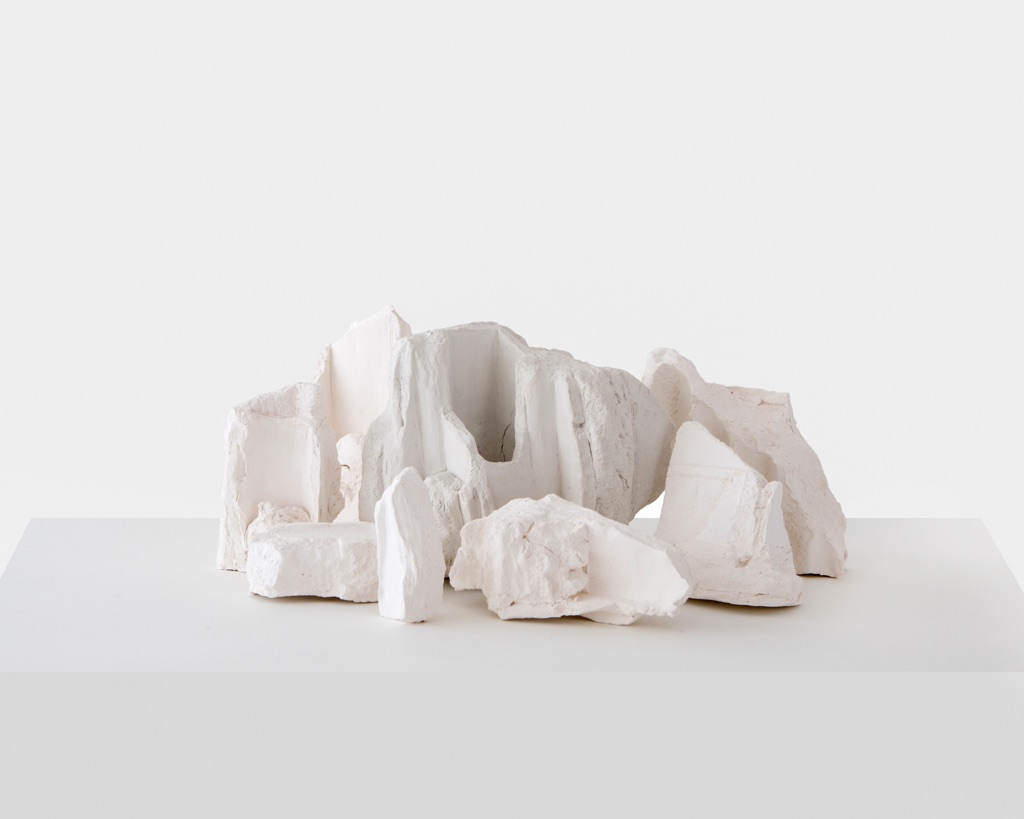
“What strongly connects me to the period we are living through is not a single artwork, but a body of work, very important also for the development of my artistic language: Brancusi’s photographs.
Brancusi, as is well known, was a sculptor, but he was also an exceptional photographer. He built his own darkroom inside his studio, sought some technical advice from Man Ray, and then embarked on an interesting process where he used photography both for himself to visualize the sculptural work in its transformation and for the viewer, by introducing an external, voyeuristic gaze to observe the studio and the creative process itself.
In his photographs, Brancusi makes his sculptures exist in another space, forcing us to see them as he would have wanted. These images bring me back to this challenging time we are living because I find them a wonderful exercise in presence.
To observe the space we live in by connecting with the pulse of light that shapes and transforms moment by moment what belongs to our intimate and everyday space. To observe what emerges from our actions, or the landscape created by the random movement of the objects around us. To notice how the light coming through a window can transform any ordinary object into a sacred one.
This, but also a relationship with time capable of not clinging to anything, of not forcing, not rushing, simply being, observing, with the patience and trust that something beautiful and powerful will happen, or rather, is already happening.”
Constantin Brancusi (1876–1957), a French artist of Romanian origin, is best known for his distinctive abstract sculptures in which he seeks the simplification of form in order to unleash the tension and energy of the material.
The development of his ideas and his unique style took place during a crucial moment in art history. Brancusi lived in Paris, a crossroads of countless cultural influences of the time, which allowed him to come into contact with key figures essential to his artistic research, such as Amedeo Modigliani (1884-1920), Fernand Léger (1881-1955), Marcel Duchamp (1887-1968), and Man Ray (1890-1976).
Alongside sculpture, Brancusi was also particularly active in the field of photography, a passion that began in 1927 when he met Man Ray in Paris. While the American artist was setting up his photographic studio, he helped Brancusi acquire the equipment needed to create a darkroom in his atelier, where he would perfect his photographic techniques. It was thanks to Man Ray that Brancusi learned to shoot, develop, and print his own photographs independently.
The result of this training is evident in the autumn 1921 issue of Little Review, which reproduces a series of Brancusi’s photographs considered among the most important shots of the period.
Brancusi’s photographic works depict images of his studio and sculptures, not simply as documentation of the works themselves, but rather as an alternative way to perceive his sculptures in relation to the surrounding environment and the changing light upon them. His photographs are a fundamental part of Brancusi’s artistic career because they guide and enhance the viewer’s experience in understanding his three-dimensional works, while also transforming them completely into new works of art. By positioning and repositioning the sculptures in his studio, Brancusi creates complex compositions that express a unique photographic vision far beyond simple documentation, firmly establishing him as one of the most extraordinary image-makers in the history of photography.
Biography
Marco Maria Zanin | Marco Maria Zanin was born in Padua in 1983.
He graduated first in Literature and Philosophy and then in International Relations, obtaining a master’s degree in Psychology. At the same time, he developed his artistic activity and undertook numerous stays in various parts of the world, practicing a crucial exercise of “displacement” for the critical analysis of social contexts and to nourish his research aimed at identifying the common spaces of the human community. Myth and archetype, as submerged matrices of contemporary behaviors, are at the core of his investigation, which unfolds through the observation of the relationship between humans, territory, and time. He lives and works between Padua and São Paulo, Brazil.