“I was born in Reggio Emilia and lived in my hometown until I was 15. After graduating from the Art High School, I continued my education at the Academy of Fine Arts in Venice, where I had already moved.
At the age of 15, I started attending the art circles in the lagoon city, and it was here that I met Edmondo Bacci, an important artist who taught at the Academy.
Bacci, an ‘informal’ artist, known for his series of paintings entitled ‘Avvenimenti’, frequented Peggy Guggenheim’s home in the 1950s. He was a person and artist of great value, yet modest. He introduced me to Peggy and her events, and there I had the incredible luck to make contact with and get to know some legends such as Chagall (1887-1985), Max Ernst (1891-1976), Léger (1881-1955), Pollock (1912-1956). Some in person, others through their works.”
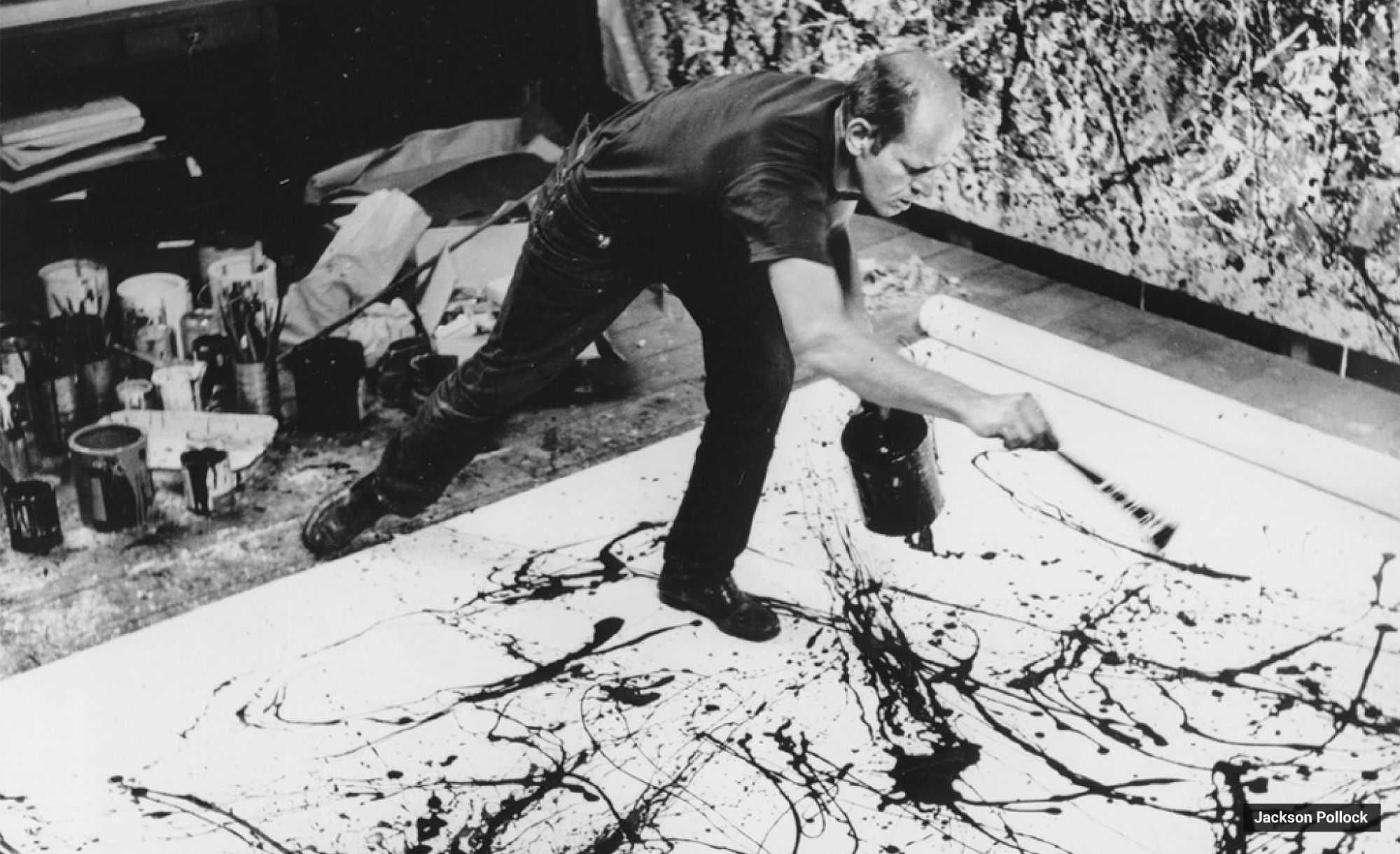
“It was 1955-56. The encounter with Pollock’s work was a revelation. The sense of freedom, creative force, and energy emanating from his pieces convinced me that the path I had chosen was the right one: I wanted to become an artist, without a doubt.
But at that moment, I also made a bigger decision: one day, I would exhibit at the Guggenheim in New York. Pollock transfers pure energy into his works, almost primitive, with the complete filling of the canvas, contrasting with an equally primitive ‘fear of emptiness’.
His gesture also refers to the Native Americans, whose artists created anthropomorphic figures and geometric elements through the falling of sand and colored powders.
But Pollock brought a new way of making art with action painting, and his works convey that sense of freedom and aspiration to something, with vigor, that somehow shook me. And my aspiration, which became almost an obsession from that moment, was to become an artist and exhibit one day at the Guggenheim in New York. This happened in 1998, more than 40 years later.
But the feeling I had when I opened my exhibition in New York was strong: I thought of that 15-year-old boy who, many years earlier, set a dream in his head and stubbornly chased it for a lifetime.
Old age begins when regrets replace dreams: it’s perhaps a rhetorical phrase, but true. These days I am turning 80, but at home, I always have white walls, to have the feeling of thinking of something to fill them, to look toward the future.
Dreaming is the key to everything, even in these times.”
Biography
FABRIZIO PLESSI | One of the leading figures in video art and multimedia language. His video installations and video sculptures, often centered around the themes of water and fire, combine monitors with structures made of wood, iron, stone, objects, or various materials, creating emotionally powerful solutions focused on the multiple possibilities of interplay between image, sound, light, and movement. Present in the most important contemporary art museums, Plessi has received numerous recognitions. Major retrospectives include the Guggenheim Museum in New York (1998), the Scuderie del Quirinale in Rome (2002), the Martin Gropius Bau in Berlin (2004), and the Mario Mauroner Contemporary Art gallery in Vienna (2005). Of particular significance are his site-specific installations created for ancient, Gothic, Renaissance, and monumental spaces such as Piazza San Marco in Venice, the Valley of the Temples in Agrigento, the Sala dei Giganti at Palazzo Te in Mantua, and the Teatro La Fenice in Venice. These interventions aim to keep the dialogue with classicism alive, with the intention of connecting the past to the future. He is well represented in the collection of the Alberto Peruzzo Foundation.