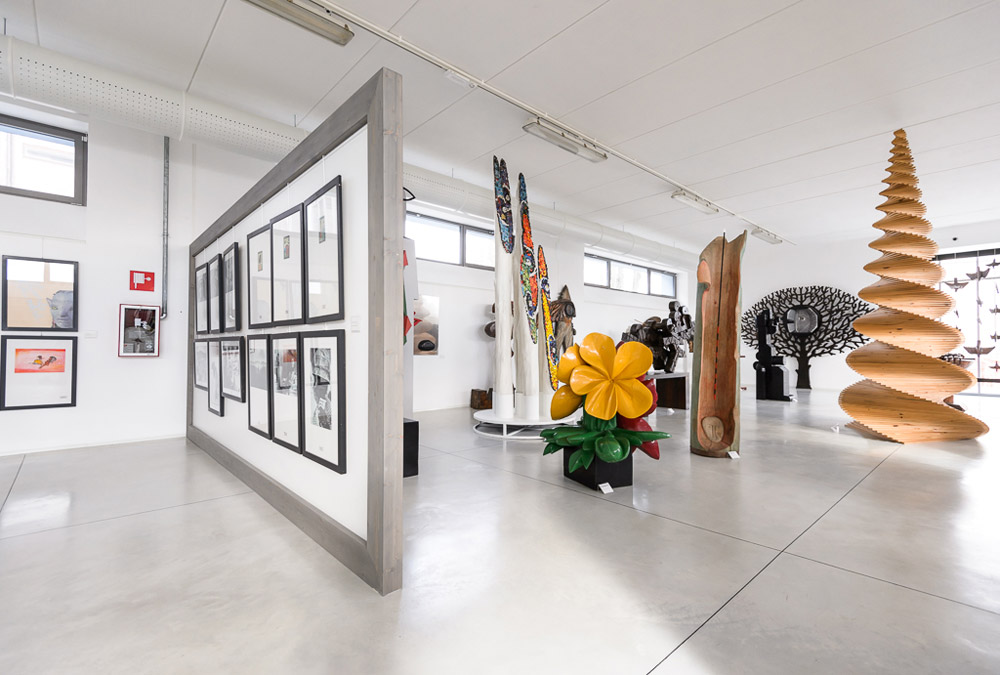
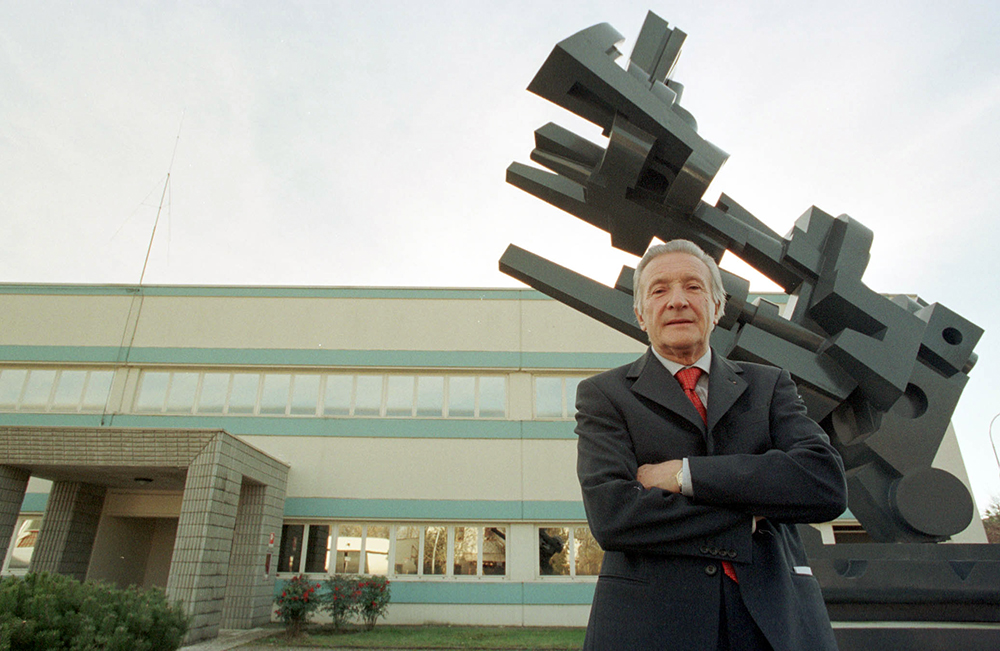
An old silo from the 1930s, located in Pieve di Cento, a small town in Emilia along the banks of the Reno River, has housed for several years one of the largest private art collections in Italy. We are talking about more than 2,000 works, gathered in a curious, passionate, and eclectic way by Giulio Bargellini over nearly fifty years of activity.
In the 1970s, the entrepreneur led his company Ova Bargellini to a leading position in Europe in the emergency lighting sector. But it was precisely during those years, he recalls, that a friend suggested acquiring two drawings by Tono Zancanaro, who was exhibiting in a solo show in Cento: he visited the exhibition, met the artist with whom he became friends, and from there began his passion for collecting.
The MAGI ‘900 Museum opened its doors in 2000 and immediately embodies the relationship between art and entrepreneurship. It presents itself as a squared and austere building, a repurposing of an old industrial structure. It is a silo, chosen by Bargellini “to protect and enhance a building in severe disrepair but of great symbolic value for the local community and for the agricultural history of the Bologna province.”
The conversion project, overseen by architect Giuseppe Davanzo, preserved as much as possible the volume of the silo by constructing a second building body composed of a large base and a new glass tower providing access to the reception, office spaces, cafeteria, bookshop, and exhibition areas.
The external walls of this “new box” are painted with a painterly texture dominated by blue hues: from afar, it appears compact; up close, it becomes tactile and mutable.
After the initial core was inaugurated in 2000, the museum was expanded a second time between 2005 and 2006 by annexing a new volume to the external staircase, and a third time in 2015 with the construction of a new three-story building above ground and a large panoramic terrace.
The focus of the collections is on 20th and 21st-century art, featuring artists such as Afro, Alviani, De Chirico, D’Orazio, Jenkins, Modigliani, Parmiggiani, Santomaso, Shimamoto, Wesselmann, just to name a few. Over the years, Bargellini has also launched ambitious temporary projects.
In 2008, he invited Shozo Shimamoto to perform one of his large-scale performances, during which, in front of a large audience and to the rhythm of music, the artist forcefully and randomly threw several containers of paint onto a long stretch of canvases and sculpted heads, following the Gutai poetic.
In 2018, the museum hosted the exhibition Guernica Icon of Peace, showcasing the preparatory sketch of Pablo Picasso’s masterpiece, which inspired the tapestry displayed at the entrance of the UN Security Council chamber (later exhibited in Padua thanks to the Alberto Peruzzo Foundation, for the 100th anniversary of the Armistice of World War I).
Regarding the relationship between art and entrepreneurship, of which he was one of the first interpreters, Bargellini stated in Collezione da Tiffany: “Collecting has changed my relationship with my clientele. My passion for art has brought me greater prestige and improved my public image, and therefore that of the company as well. I say this without any false modesty — my passion for art truly helped me in my work for a certain period. I have been an inventor in many fields, including this one. Now that the museum is my main commitment, I am increasingly convinced that I have successfully reconciled work and passion.”