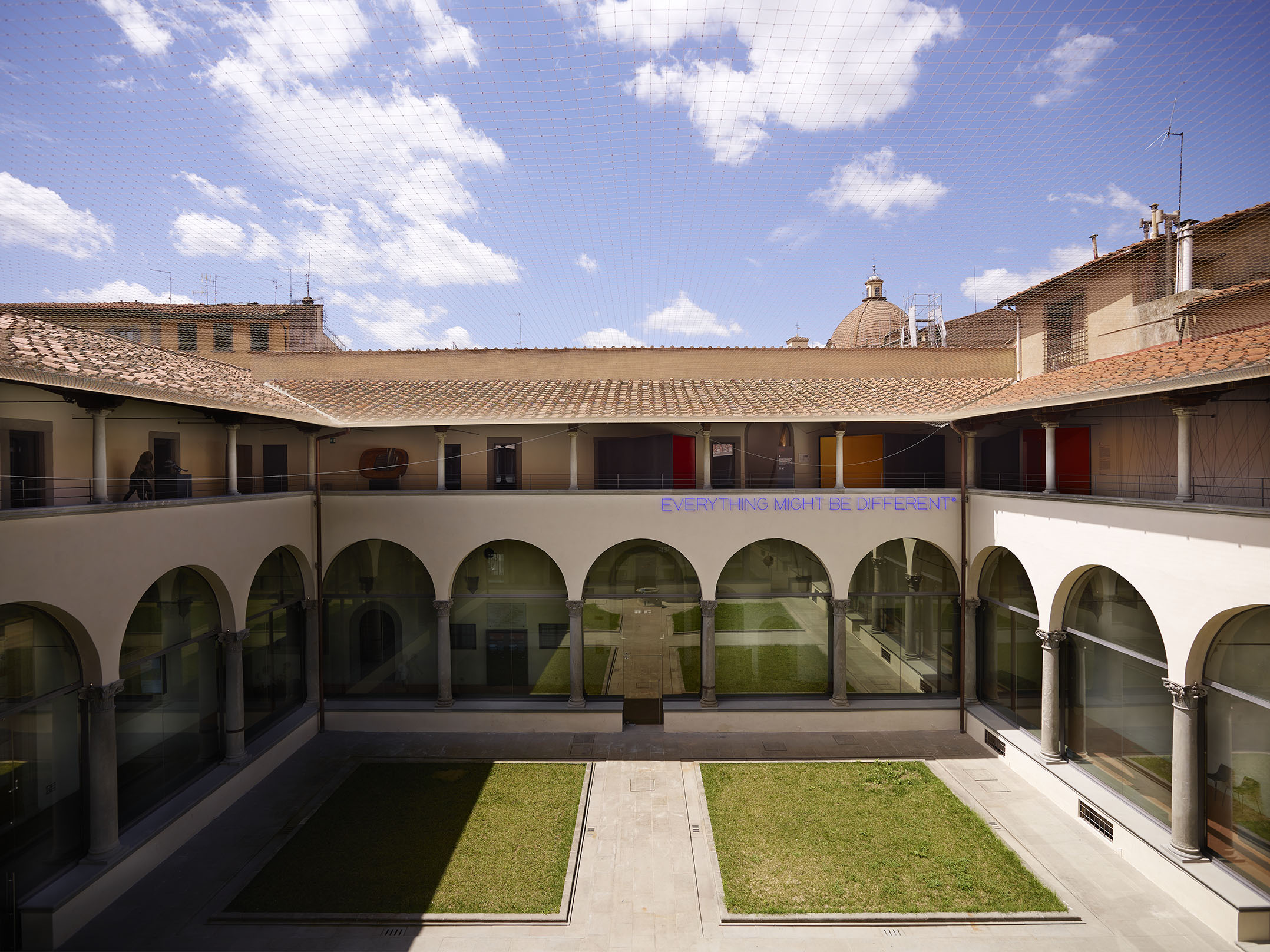
The location is the ancient Spedale delle Leopoldine in Piazza Santa Maria Novella, Florence. This historic Florentine convent complex dates back to the early 13th century, built on the site of a pre-existing 4th-century church, and was also known as the Spedale di San Paolo dei Convalescenti. Initially, it served as a hospice for pilgrims and became a hospital in 1345. In 1780, the hospital was permanently closed and transformed into one of the four Leopoldine Schools in Florence, established by the Grand Duke to expand education for young Florentine women.
At the end of the 20th century, the Municipality decided to redevelop the complex for cultural purposes, starting with the restoration of the loggia and continuing in subsequent phases. The first phase was completed in 2006 with the opening of the Alinari Museum, and the final phase involved the arrangement of the Museo Novecento, which opened in 2014. Today, Museo Novecento is dedicated to 20th-century Italian art and offers a selection of about 300 works displayed across 15 rooms.
Among the featured artists are De Pisis, Depero, Casorati, Morandi, Severini, and Vedova. Since the arrival of the new director, Sergio Risaliti, in 2018, the museum has undergone a major transformation, opening up much more to 21st-century art.
One of the main new initiatives is the intense exhibition activity focused on contemporary art, aimed at rediscovering the permanent collection. This is embodied in the DUEL cycle, which refers to a dialectical duel between contemporary artists and the civic museum’s heritage. DUEL involves guest curators collaborating with internationally active artists to select a work from the museum and engage in a dialogue with it.
In 2019, Goldschmied & Chiari developed an intervention around the idea of the “double,” choosing Mario Mafai’s painting Demolizioni (1937). Also in 2019, Davide Balliano selected Arturo Martini’s sculpture Susanna to create his own intervention on the theme of waiting, using paintings, sculptures, and photographs.
Currently ongoing is the exhibition Routes by Elena Mazzi (born 1984 in Reggio Emilia), who chose three works from the collection (by Guttuso, Sironi, and Prampolini). The exhibition is structured as an imaginary journey starting from Sicily, crossing Italy, and then leading to Iceland and China, suggesting various possible trajectories.
Another original exhibition format launched by Risaliti is THE WALL, which takes the form of a visual elaboration typical of infographics on a 12-meter-long wall. This series cyclically presents unusual and eccentric topics using easily understandable words and images, always proposing new interpretative hypotheses to museum visitors.
On another 12-meter-long wall is OFF, which aims to broaden the discourse on art towards social participation to contribute to building a new humanism, a public art project that moves from the museum into and through the city in a play of references and back-and-forth movements. The wall, painted in the colors of the Italian flag, periodically hosts an artwork that tunes into the urgencies and emergencies of our time.
Since June 13, Ho Fame by Paolo Canevari has been confronting reality without merely commenting on it. The exhibited work is simultaneously reproduced on the pages of local newspapers or on posters of various formats throughout city streets. Ho Fame (meaning “I’m hungry”) originates from the signs held by many homeless people on the streets: the phrase Ho Fame, traced in white, shines on the windshield of a black Rolls Royce. This creates an evident conflict between that symbol of wealth, the car, and the phrase, a cry of extreme poverty, between words and forms. This theme is especially urgent for the artist within the context of the crisis caused by COVID-19, which created an emergency for artists.
Among the exhibitions presented in spring 2020, the Museo del Novecento dedicated a solo show to Allan Kaprow, famous for being the father of Environments and Happenings. Kaprow laid the foundations for a new conception of artwork, intertwining art and life, and promoting an idea of conceptual, utopian, and spontaneous art.
The ability to juxtapose 20th-century art, part of the permanent collection, with contemporary artistic expressions will also be one of the goals for the Church of Sant’Agnese, once it reopens to the public. The church is still under restoration, and its revitalization is part of the project of the Alberto Peruzzo Foundation.