I would like to share the story of a meeting, an exhibition, and a work of art to which I am particularly attached, one that marked the beginning of a beautiful friendship and taught me the value of an artist. It was the early days of November 2015, and for the second consecutive year, I was fortunate to be hosted in New York by Andrea Mastrovito, one of the most generous artists I have ever met. It was a week dedicated to visiting artists’ studios that had been recommended to me by museum curators, gallerists, or that I had already arranged to visit beforehand.
Among the artists I wanted to meet was Rashid Johnson, who was holding a solo exhibition at the Drawing Center. Unfortunately, in the preceding months, it had been very difficult to get in touch with him due to his many commitments, including a major exhibition at the renowned Garage Museum of Contemporary Art in Moscow, which was scheduled to open in March 2016, just a few months away. Shortly before leaving for New York, at the GAMeC in Bergamo, where I had worked for several years as a curator thanks to Giacinto di Pietrantonio, the opportunity arose to organize an exhibition in Spazio Zero, and thus the unlikely idea was born to ask Rashid to put together a show in just a few months.
I sent yet another email on October 28th, and Alex Ernst, Rashid’s very skilled assistant, confirmed the appointment for Wednesday, November 4th, 2015, at 3:00 PM at the Drawing Center. While waiting, I was quite anxious perhaps because the exhibition featured a beautiful series of drawings from the now-famous Untitled Anxious Men. The gestural quality of Untitled Anxious Men is so evident and obsessive that it feels like a frenzy, an obsession, a performative dance the artist performs, bringing the painting to life in the space of his studio. I clearly remember Rashid’s big smile and greeting to the museum attendant when he entered; it immediately eased the tension I had built up. We started chatting as if we had known each other for a long time about his works, his family, and his love for poetry.
From the Drawing Center to the counter of a bar, where he ordered a hot tea and I had a sparkling water. Without much preamble, I proposed the idea of doing an exhibition together. “Sure, when?” he replied. “February,” I said. “Good, we have more than a year to work on it,” Rashid thought and said. When I told him it wouldn’t be in fifteen months but in just three, he had a little start, he was probably thinking I was crazy to ask him something like that. I gathered my courage and tried to explain why it made sense to do the show, how I saw his work, and that yes, the show at Garage a few weeks later would be great, but we would definitely have fun making ours together. I still remember him asking to see the floor plan of the space, which I luckily always carry with me. I told him the story of GAMeC and the space—a former monastery—we quickly built the structure of the show, and then he called his gallery saying he wanted to do this project.
Among the elements frequently found in Rashid’s exhibitions, various types of plants hold a prominent place. The use of this “material” is particularly interesting because it serves no decorative purpose and stands apart from the forms and gestures of his entire body of work. The use of plants falls within a practice that the artist himself calls “Hijacking of Domestic,” which can be defined as: “the memorialization of the process of appropriation and re-translation of domestic space.”
Plants are visual elements that foster a feeling of being welcomed into a hospitable environment, while maintaining a strong connection between the outside world and familial imagination. The appropriation and hijacking of codes thus become functional elements in the process of metabolizing and blending opposing concepts such as interior/domestic and exterior/public.
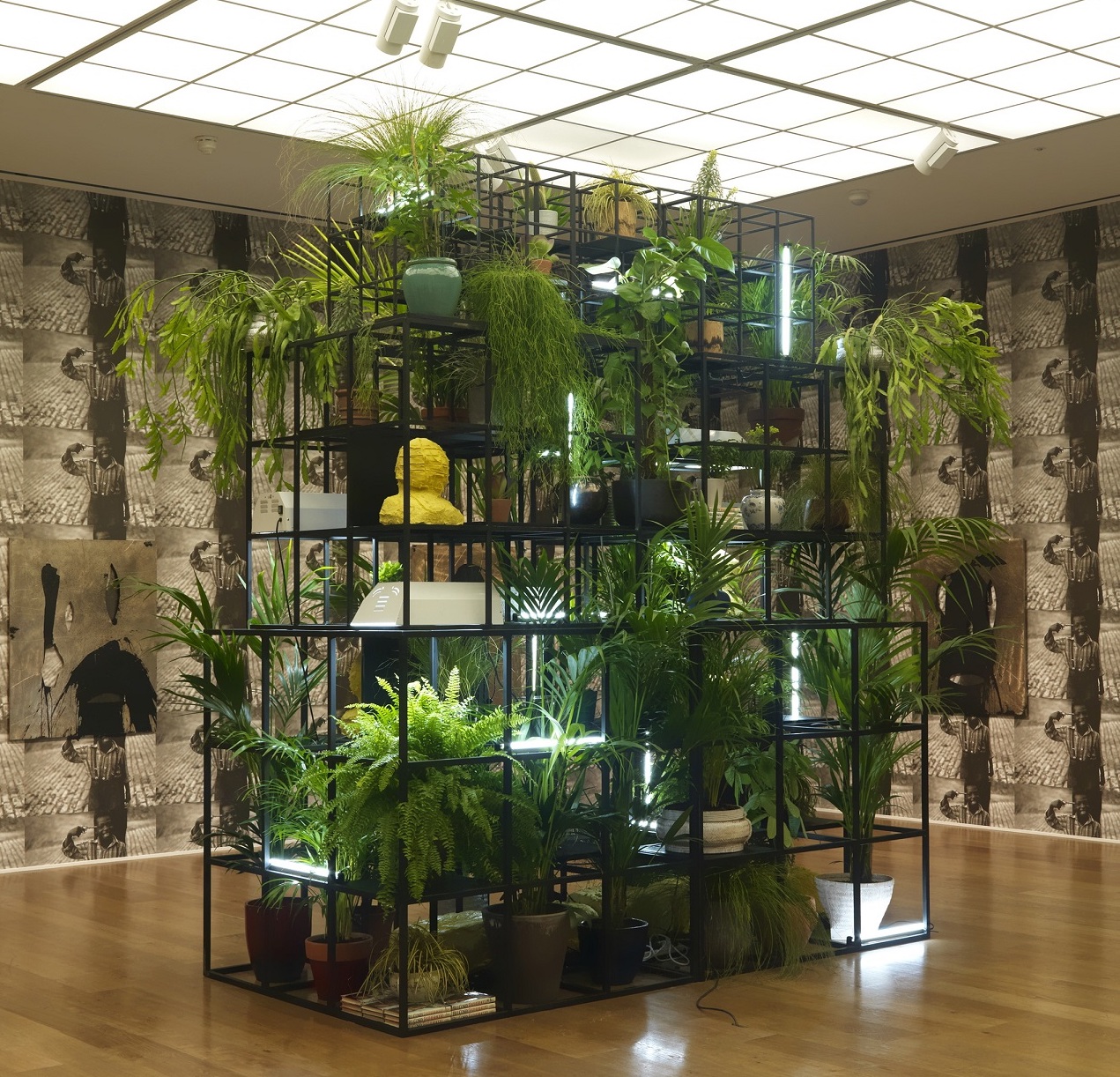
Moreover, what makes plants so special is that they breathe. Breathing is the most vital element, in the literal sense, and probably also the most direct physical emanation of the artist, not a self-portrait, but a living system that takes over and colonizes the space. For this reason, Fatherhood was given the central place within the exhibition.
The sculpture is composed of a three-dimensional grid of steel cubes of varying sizes. The hollow forms are stacked one on top of the other to create a cage-like, totemic installation that recalls the minimal structures of Sol LeWitt and the modular compositions of Carl Andre.
Conceived as a living organism, or a form of delocalized psyche, the sculpture overflows with houseplants and grow lights that support their survival. The breathing of the plants is the background noise of Rashid Johnson’s universe.
The exhibition curator, who suffers from vertigo, asked the artist to take care of it, and there was nothing more beautiful than breathing alone in that space.
Biography
STEFANO RAIMONDI | Born in 1981, he is a curator, art promoter, and Artistic Director of ArtVerona. Since 2010, he has been the director of the cultural network The Blank Contemporary Art, with which he annually organizes the Contemporary Art Festival ArtDate and has curated solo exhibitions of Nathalie Djurberg & Hans Berg, Eva & Franco Mattes, Jonas Mekas, and Deimantas Narkevičius.
He was Curator at GAMeC – Galleria d’Arte Moderna e Contemporanea in Bergamo from 2011 to 2017, where he curated solo exhibitions of international artists such as Cory Arcangel, Rochelle Goldberg, Rashid Johnson, Andrea Mastrovito, Ryan McGinley, and Pamela Rosenkranz.
From 2013 to 2017, he curated Qui. Enter Atlas – International Symposium of Emerging Curators.
In 2011, he co-founded BACO – Base Arte Contemporanea, for which he curated exhibitions by Francesco Arena, Riccardo Beretta, Filippo Berta, Ettore Favini, Oscar Giaconia, Daniel Knorr, Jacopo Miliani, Israel Lund, Navid Nuur, Adrian Paci, Dan Rees, and Guido Van Der Werve.
From 2015 to 2017, he taught at the Academy of Fine Arts in Verona. He is a member of the IKT – International Association of Curators of Contemporary Art.