In these dramatic days marked by the pandemic emergency, the entire world is united by a profound sense of fear not felt since the times of World War II. Even then, just like us in this particular period, those involved vowed to build a “new world” at the end of the emergency, a better world based on civilization, progress, and brotherhood among peoples.
Well, in 1960 this actually came true: the world truly united under these hopes, leaving posterity with a kind of modern fairy tale, still waiting to be told.
This story begins around the mid-1950s and is set in Egypt, a country that, over the course of about a hundred years, had quintupled its population but was unable to produce enough resources to feed it. Faced with this humanitarian emergency, the FAO, the United Nations organization for agriculture and food, advised the Egyptian government to build a new dam on the Nile to improve the living conditions of the population.
The water from the new dam would, in fact, combat drought, promote cultivation, and generate the electricity needed to start the country’s industrialization.
The flooding would create a vast reservoir, later called Lake Nasser, covering an area of over 5,000 square kilometers in the Nubian region, raising the level of the Nile by about 60 meters. The solution proposed by the FAO proved suitable for the needs of the Egyptian population, but at the same time involved the dramatic disappearance of 24 monuments, as well as everything buried by the sand and yet to be discovered, lying along the Nile in the Nubian area affected by the flooding.
The testimonies of the ancient Egyptian civilization would be submerged forever, in exchange for the salvation of the population.
A ruthless choice that neither the Egyptian government nor the Sudanese government (the two states encompassing the Nubian region) were willing or able to face in all its dramatic severity: thus, they decided to turn to UNESCO, the United Nations Organization for Education, Science, and Culture, desperately seeking technical (and financial) solutions to save the historic monuments from flooding.
In January 1960, the construction of the great Aswan Dam (called in Arabic “the High Dam”) began, and on March 8 of the same year, the then Director-General of UNESCO, Vittorino Veronese from Vicenza, launched from UNESCO’s headquarters in Paris a heartfelt appeal, the first in history, to ALL the nations of the world, urging them to contribute people, knowledge, and resources to save the testimonies of an ancient civilization.
Here are the words chosen by Veronese on this historic occasion:
“Wonderful structures, considered among the most astonishing on earth, are in danger of disappearing beneath the waters. The dam will bring fertility to vast stretches of desert; but opening new fields to tractors, the prospect of new energy for future industries, comes at a very high price. (…) It is not easy to choose between the heritage of the past and the present well-being of a people (…) it is not easy to choose between temples and harvests. (…) These monuments, whose loss may be tragically near, do not belong solely to the countries that safeguard them. The entire world has the right to see them endure through time. They are part of a shared heritage that includes the thought of Socrates and the frescoes of Ajanta, the walls of Uxmal and the symphonies of Beethoven. Treasures of universal value call for universal protection. When something beautiful, whose value increases rather than diminishes when shared, is lost, then we are all equally lost.(…)”
Such a noble cause deserves nothing less than a generous response. It is therefore with great confidence that I invite governments, institutions, public and private foundations, and people of goodwill, wherever they may be, to contribute to the success of this unprecedented undertaking in history. We need expertise, resources, and money. There are countless ways in which everyone can help.
The response to UNESCO’s appeal was nothing short of a miracle: 122 nations joined the effort, with support coming from public and private institutions as well as ordinary citizens, students, and teachers from all over the world; even children organized fundraisers to help. International media, radio, television, and print, spontaneously united to contribute to the campaign’s success.
It had been only 15 years since the end of the Second World War, a slaughter that had spared neither the historical and artistic heritage of the nations, which had largely been damaged by bombings.
John Fitzgerald Kennedy, then President of the United States, responded to the appeal as follows:
“The United States, one of the youngest civilizations, has great respect for the study of past cultures and a strong interest in preserving one of the greatest achievements of art and thought. I therefore recommend that we now join the other nations through UNESCO in preventing what would otherwise be an irreparable loss to the science and cultural history of all humanity.”
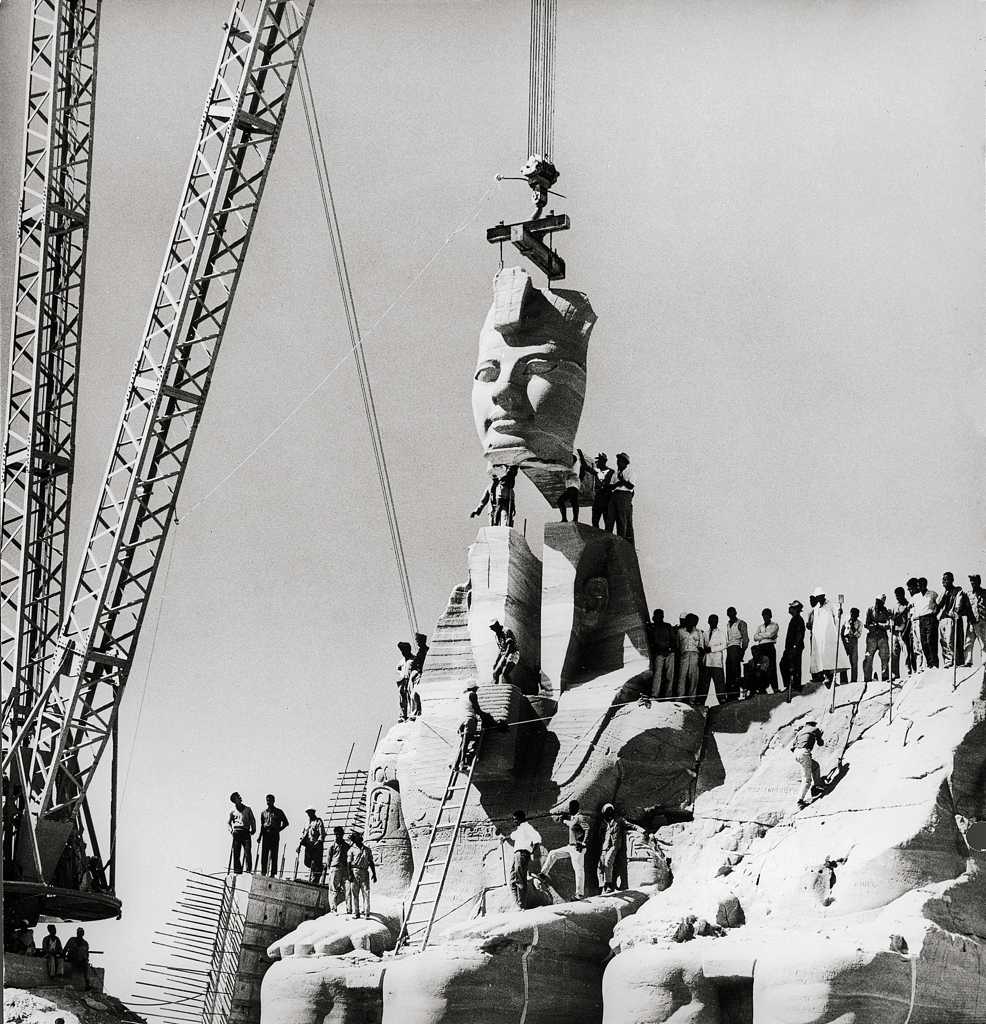
From all over the world, 30 archaeological expeditions were sent to Nubia (for Italy, the universities of Turin, Milan, and Rome) to carry out new excavations and to document the monuments destined to be flooded. UNESCO sent the Italian architect Piero Gazzola, former Superintendent of Western Veneto and expert in monument restoration, to survey all 24 temples along the Nile and study possible techniques for their preservation. Except for three small temples that were lost, the Nubia campaign saved, over the course of twenty years, the extraordinary testimonies of the ancient Egyptian civilization along the Nile, from the temples of Philae to the splendor of Abu Simbel (whose rescue was significantly aided by the Italian construction company IMPREGILO). The results of the archaeological excavations greatly expanded our scientific knowledge and gave a tremendous boost to Egyptology.
In 1979, “The Monuments of Nubia from Abu Simbel to Philae” were recognized by UNESCO as an “open-air museum” and declared a World Heritage Site. In its recommendations, ICOMOS, the International Council on Monuments and Sites of UNESCO, stated:
“The success of the campaign launched to the world through UNESCO would alone suffice to prove (if proof were needed) that these monuments are, in fact, perceived as the heritage of all humanity.”
This great endeavor truly changed the world, demonstrating the importance of solidarity among nations and the benefits of shared responsibility in the conservation of universal heritage. Today, we too must be protagonists of a “great endeavor,” and we can do so through the world heritage that includes, as per the 1972 UNESCO Convention, natural heritage as well. Themes such as solidarity among nations and shared responsibility must now be applied to the conservation of our planet, our marvelous natural world heritage, its limited resources, and its fragile balance.
It is now up to us to write a new modern fairy tale that future generations can gratefully continue to tell.
Biography
PAOLA CATTANEO | Architect and Chartered Architect at RIBA, The Royal Institute of British Architects, since 2011. Member of the ARB, Architects Registration Board in London. She designs contemporary architecture projects and conservation restorations. She is a contract professor specializing in cultural heritage at the CIELS University Institute in Padua.