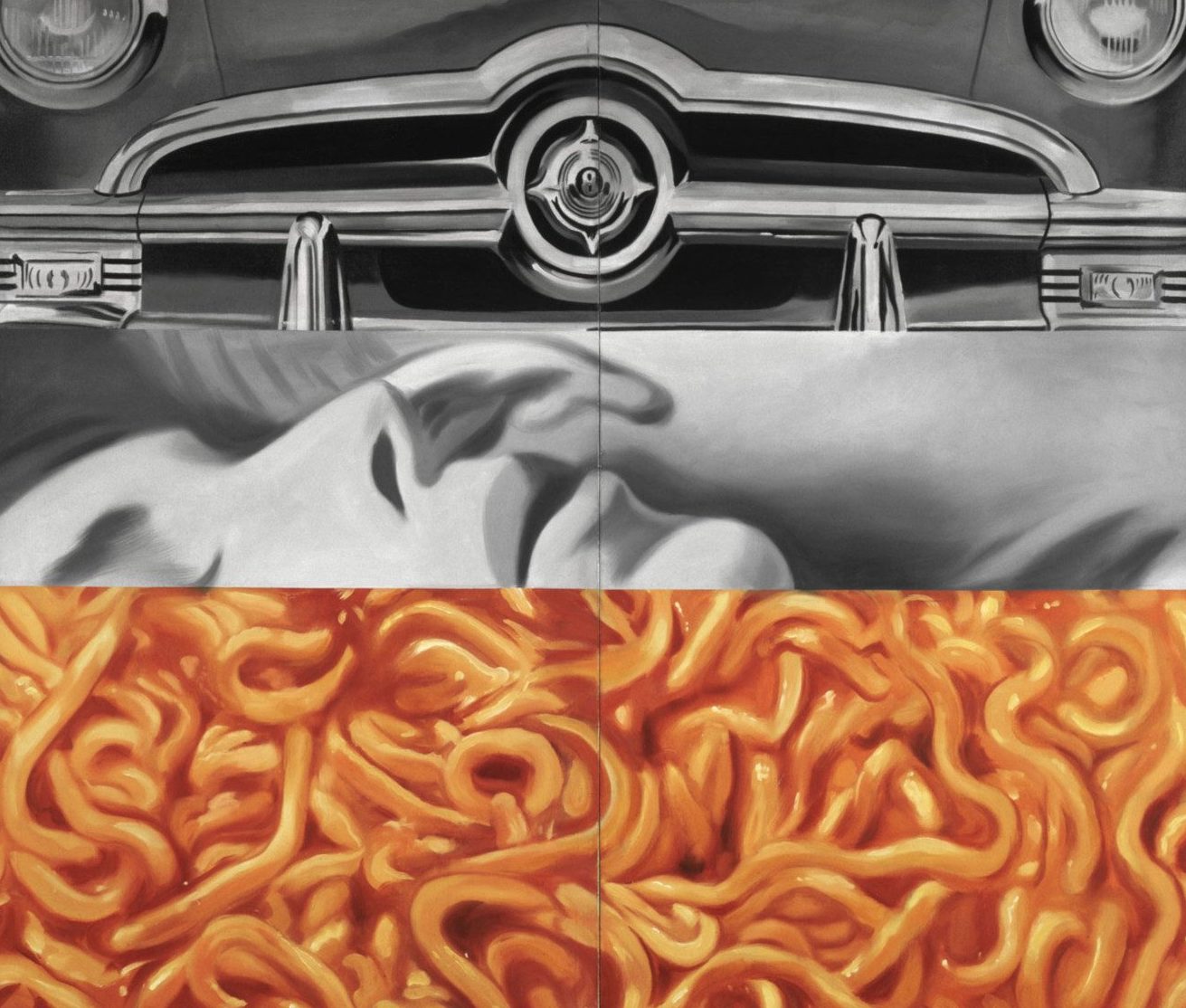
There have been at least two events that marked something significant in my professional and personal journey. The first took place during New Year’s Eve in 2003, when I was in New York visiting the great museums: the Museum of Modern Art (MoMA), the Whitney Museum, and the Guggenheim, where I saw a beautiful retrospective of James Rosenquist (1933–2017), an American painter considered one of the pioneers of Pop Art alongside Andy Warhol and Roy Lichtenstein. I was struck by these large works, especially for their expressive power, majestic pieces I had never seen in person before. This grandeur and energy truly touched me.
In his polychrome, varied, and vibrant works, Rosenquist uses images and objects borrowed from popular culture, everyday life, and the mass media. He draws inspiration from comic books, common products, and especially advertising. He also addresses socio-political themes. His work is characterized by continuous technical experimentation. As he stated in a 2007 interview: “I’m not like Andy Warhol. He made Coca-Cola bottles and Brillo pads. I used generic, unbranded images to create a new kind of painting.”
At that time, as in the previous year, I was living in London. It was my period of discovering contemporary art; I often visited various museums, where I liked to go alone to reflect and think about other projects, creatively stimulating the birth of new ideas and initiatives. That place made me think of other things. Very often, cultural venues are also fertile grounds for other ideas and new things to be realized, they stimulate creativity by putting you in contact with it.
The second event that marked my path happened a few years later during the MIA Art Fair, where I saw the director of a museum speaking. When I heard him, I said to myself: “I would love to work with someone like that and get to know the kind of institution he works in.” And that’s exactly what happened. Shortly after, I moved to Vienna and began working at the Kunsthalle. That’s where my journey of exploring and deepening my knowledge of contemporary art began on a professional level as well.
This difficult quarantine period is not entirely new to me. Very often, when I was in Vienna, I used to stay at home for days on end, working, writing, and doing research. I was also quite alone, but I didn’t mind because I had a strong motivation that came from pursuing my goals—above all, from studying and delving into something I truly loved.
That is the message we should take away today: let’s use this time of isolation to deepen our understanding of artists, art and other art forms by watching performances on TV, films, listening to music, and discovering new works. Let’s make the most of this moment to be more in touch with ourselves. Art helps us to better understand who we are and is a powerful tool for inner dialogue.
Biography
ALESSIA ZORLONI | She is a professor at IULM University in Milan, where she teaches theories and forms of the art market. She has conducted consulting and research work on museum management for various institutions and organizations, including the Boston Consulting Group, Kunsthalle Wien, Tate Gallery, Guggenheim Museum, and Smithsonian Institution. Her research has been published in academic journals and recognized with international awards, including the Smithsonian Fellowship in Museum Practice, the Marie Curie Intra-European Fellowship, and a three-year grant from the Austrian Science Fund (FWF). She is the author of Economia e gestione dei musei (Aracne), L’economia dell’arte contemporanea (Franco Angeli), and The Economics of Contemporary Art: Markets, Strategies and Stardom(Springer). In January 2016, she will publish a new book with Springer titled Art Wealth Management: Managing Private Collections.