A time and a place where two “enlightened” entrepreneurs, Cristoforo Crespi and his son Silvio Benigno, dreamed of building an ideal village dedicated to work along the banks of the Adda River. It was a self-sufficient urban project, designed on a human scale, where workers and artisans could live together within their community according to an ideal plan of order and harmony.
In a world far removed from globalization, where long distances could only be traveled by steam train, the Crespi family’s project was not only visionary but also revolutionary.
The village of Crespi d’Adda is a true gem of industrial archaeology. Built starting in 1878 during a period of intense industrial development, it was designed exclusively for workers and their families, with the goal of recreating a social “habitat” typical of any other city.
Construction began with the building of the factory for spinning, weaving, and later dyeing. Next to it stood the grand owners’ residence, a majestic 14th-century medieval-style manor with a tower, symbolizing the power of the Crespi family.
Over the years, the project expanded to include a power station to support the active production and a wide range of services for the community: a church, a school, a hospital, grocery and clothing shops, and various facilities for leisure and recreation. It was a small social and entrepreneurial cosmos where inhabitants could both live and work.
In addition to being ahead of its time in service provisions, this small city introduced significant technological innovations, such as electric lighting with the Edison system, to enhance both productivity and the quality of life for workers and employees. But the fascinating details of this “ideal city” of workers’ life don’t end there.
Although Crespi d’Adda is located in the province of Bergamo, its telephone area code corresponds to that of Milan. At the time, the Crespi family installed a private long-distance line connecting their castle in the village to their residence in Milan.
The school, reserved exclusively for the children of the workers, provided all necessary learning materials free of charge. The teachers’ salaries and housing were fully covered by the factory’s revenue. No expense was spared: in the early 1900s, a swimming pool was also built for the exclusive and free use of employees.
In the public baths, where residents could take turns washing, Thursdays were reserved for children, who didn’t attend school that day but instead received a token. They were required to give this token to their teacher the next day to confirm whether or not they had bathed.
Another unique service was the heated laundries: hot water was available for women year-round, and the space was sheltered by a roof, eliminating the need to do laundry at the river.
Lastly, the village church, built in full Renaissance style, is not an original design, it is a replica of the church in Busto Arsizio, the Crespi family’s hometown.
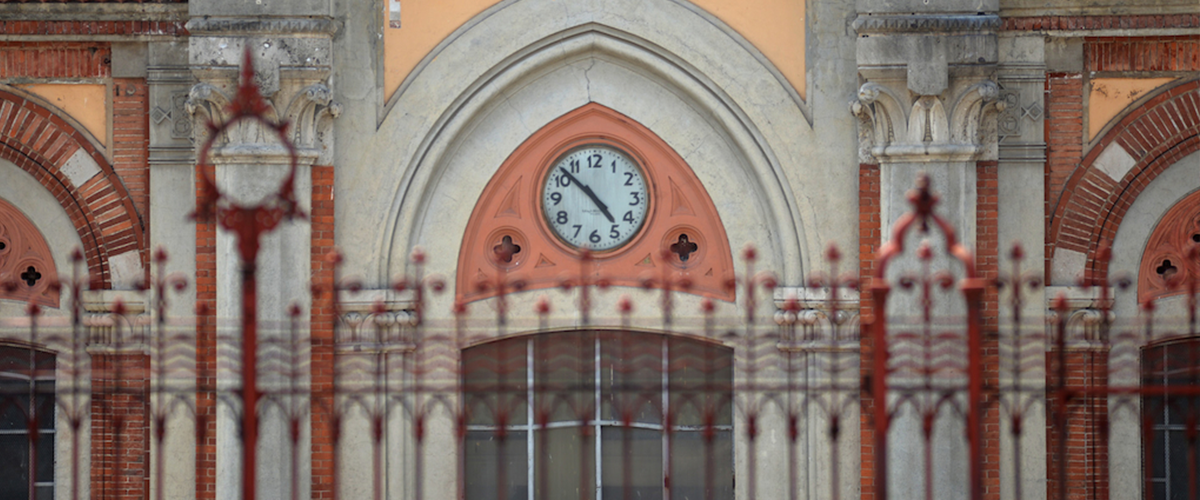
The fortunes of this place, however, came to an end in 2003, when an economic crisis brought the entire village to a collapse. At 4:52 PM on December 20th of that year, the town’s bells rang in mourning, and all the workers were forced to exit the cotton mill warehouses for the last time. To this day, the clock above the factory entrance still displays that exact time.
The story of Crespi d’Adda is one of labor, dedication, and respect over the years, and it has stood as a valuable model of reference.
The village, completed between the late 19th and early 20th centuries, remains perfectly intact today, with its urban and architectural layout largely unchanged. Its roughly fifty houses, built in a distinctive English style, are now home to the descendants of the original workers.
Since 1995, it has been included on the UNESCO World Heritage List as “an outstanding example of the phenomenon of workers’ villages, the most complete and best-preserved in Southern Europe.”