An abandoned factory converted into one of the most visited museum hubs in the world. We are talking about the Tate Modern in London, which recently celebrated its 20th anniversary. It was May 12, 2000, when the modern and contemporary art gallery was inaugurated, which would go on to welcome over 5 million visitors a year.
Located in the heart of the British capital along the southern bank of the Thames, Tate Modern occupies the space of a former power station built between ’47 and ’63, the Bankside Power Station, designed by Sir Giles Scott, the creator of the famous British red telephone box.
In 1981, due to rising oil prices and high maintenance costs, the building was forced to close. About ten years later, the Tate Gallery which at the time included Tate Britain on Millbank, Tate Liverpool, and Tate St. Ives in Cornwall decided to purchase the entire industrial site.
The construction contract was awarded to the Herzog & de Meuron firm, whose signature projects include the Allianz Arena in Munich and the Beijing stadium for the 2008 Olympics.
The result was a vast exhibition space spread across three distinct but connected areas, whose architectural structures were preserved and enhanced without altering their original appearance.
The Boiler House, part of the old power station that once housed the boilers, now hosts the majority of the museum’s galleries. The Turbine Hall, the museum’s spectacular entrance created by removing the former machinery, is used as an exhibition space for sculptural and site-specific works by contemporary artists.
An example is Maman, a work by the artist Louise Bourgeois that marked a historic moment for the British institution: it was exhibited for the first time in the Turbine Hall on the occasion of the gallery’s opening. At the time, it was met with mixed reactions of amazement and amusement. The sculpture, depicting a spider with a sac containing 32 marble eggs, is one of the largest in the world and the only one made of stainless steel. Today, it is owned by Tate Modern, which acquired the work in 2008.
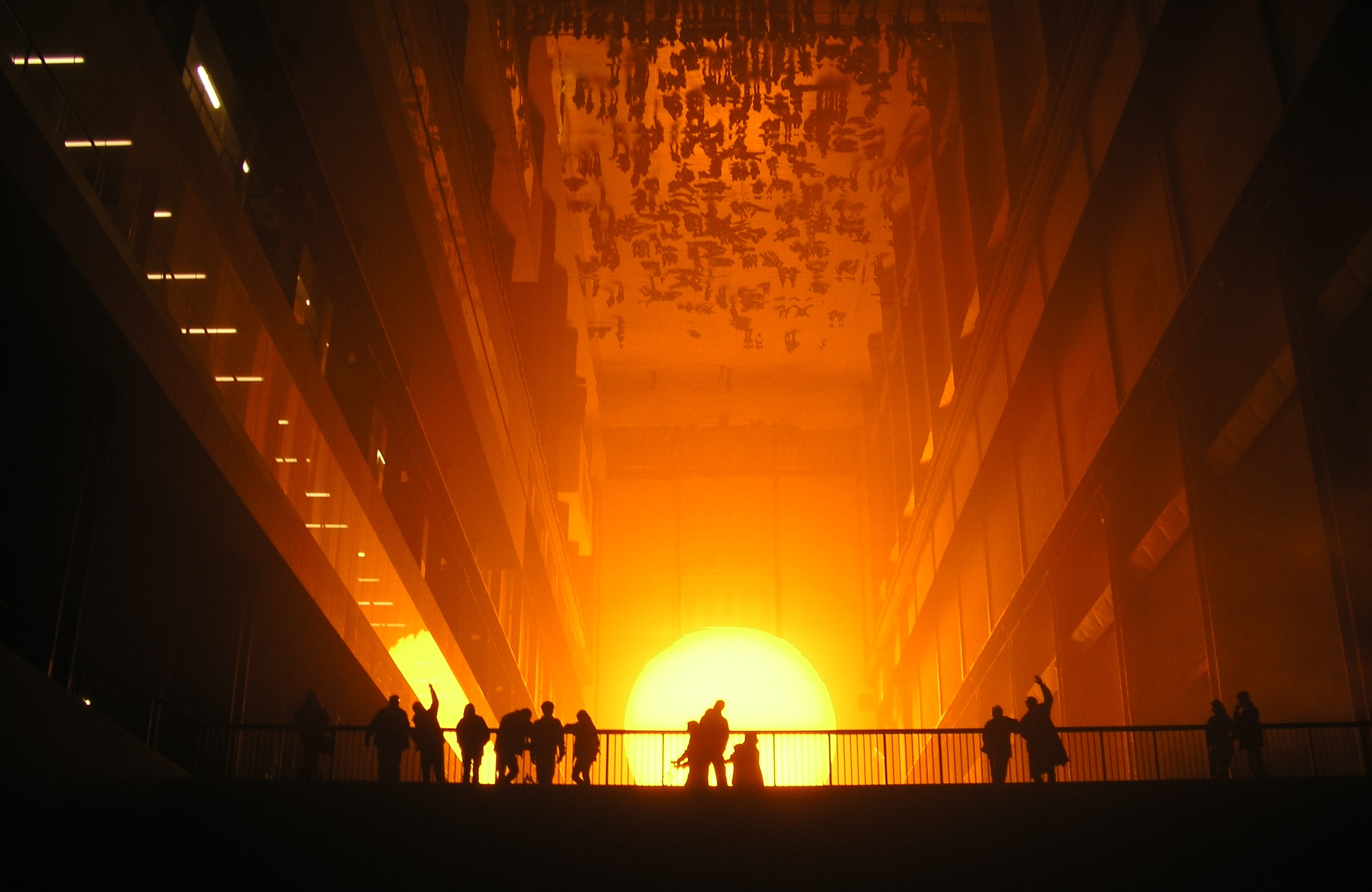
Speaking of the Turbine Hall, how can one not mention The Weather Project (2003), an installation by Danish artist Olafur Eliasson, where he experimented with light and its chromatic variations through the recreation of the Sun and all its energy. A gigantic semi-circular backlit panel hangs from a ceiling made of reflective panels that amplify the illuminated surface and the perception of the hall’s volume.
Or, how could one forget Test Site (2007), the interactive installation by Belgian artist Carsten Holler, composed of five slides made of plexiglass, glass, and metal, which anyone could experience by sliding down inside them.
Finally, the new Switch House, located in the southern part of the building where the old underground oil tanks were, adds another 20,700 square meters of exhibition space.
Today, the museum hosts both permanent and temporary exhibitions of some of the most famous contemporary artists. The exhibitions are mostly free of charge, except for a few special project shows, which is perhaps the secret to its success. According to a recent article in The Art Newspaper, in 2019 Tate Modern was the sixth most visited museum in the world, with a record attendance of over 6 million visitors; in a top ten list that includes the Louvre in Paris, the National Museum of China in Beijing, the Vatican Museums, the Met in New York, and the British Museum in London.
Among the most recent exhibitions, we recall the major retrospective dedicated to Edvard Munch in 2012, featuring over 60 works by the Norwegian artist; the solo exhibition of Fauvist master Henri Matisse in 2014; the retrospective dedicated to the father of Cubism, Pablo Picasso, in 2018; and, closer to our times, the exhibition on the father of Pop Art, Andy Warhol, which was closed just a few days after opening due to the health emergency.
For its 20th anniversary, the museum celebrated with an artistic birthday featuring Louise Bourgeois’ Maman, Yayoi Kusama’s Infinity Mirrored Room, and performances of Our Labyrinth by Lee Mingwei.
20 years and still going strong! Tate Modern has been and continues to be a triumph of architecture and urban regeneration, a city project that transformed the “ugly side” of the Thames into a must-visit destination. But the museum doesn’t intend to stop there. In fact, it plans to expand its exhibition spaces by another 60% by constructing a new building adjacent to the current one.