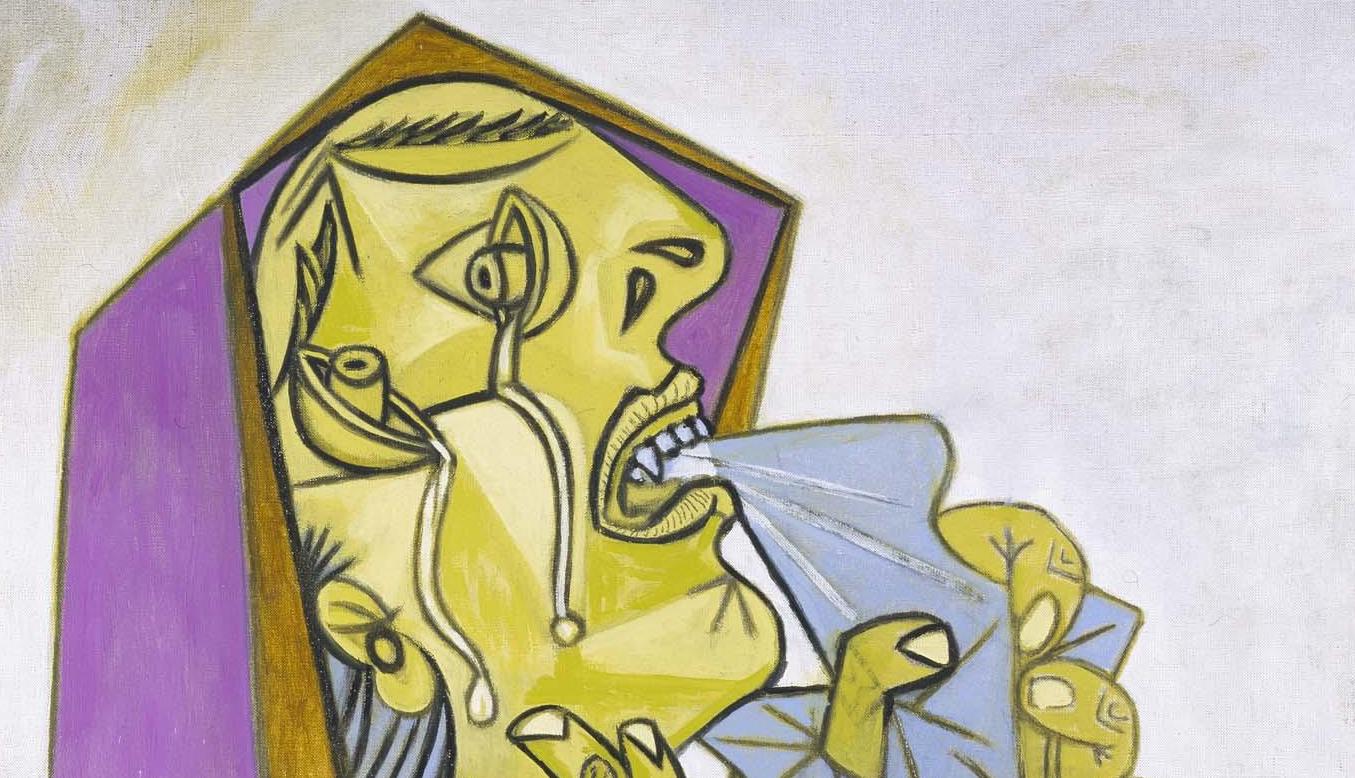
I was about 11 years old when art first entered my life. In reality, as often happens with passions, it wasn’t a polite handshake, but a bolt of lightning: I had seen Picasso! Just like with history books, I loved starting from the end: I found dates that were closer to my own years, which I could easily place on my childhood timeline, and faces of men whose names I also recognized from street signs… the possibility of transferring them from a book to real life reassured me in the face of centuries and events that felt so distant. It gave me the chance to imagine history.
And I suppose that’s why Cabeza de mujer llorando con pañuelo struck me so deeply that I still go to greet it every time I’m in Madrid, at the Reina Sofía. It was there, in contrast with Raphael, in a little chapter dedicated to the idea of beauty. And while the painter from Urbino brought calm to the soul, I was almost exhilarated by this 1937 contraction of forms, by its ability to violently unveil the woman’s pain, the tragedy of history in its acidic colors. Years later, I discovered that these portraits contributed to the composition of Guernica, and that the faces of the weeping women were inspired by the features of Dora Maar.
I still believe that I enrolled in the Istituto d’Arte in Modena because of that image. But it was an exhibition that truly changed my perception, that pushed me to enroll at the Academy of Fine Arts. It was 2002, I was 17, and one morning, instead of going to school, a friend and I took the train to Milan; he just wanted to wander around, but I had read in a weekly magazine about an exhibition titled New York Renaissance. From the Whitney Museum of American Art, at Palazzo Reale.
New York was a mirage, the Towers had just collapsed, and the idea of getting closer, even just symbolically, to the Big Apple through a series of “Pop Art masterpieces” intrigued me. As I walked from room to room, that curiosity turned into euphoria, into joy, into emotion, into ecstasy: for the first time, I was discovering America! And not on TV, not in the newspapers, but there, in the halls of a museum, where I found myself face to face with Claes Oldenburg’s giant polyurethane cigarette butts, Tom Wesselmann’s Great American Nude, Richard Estes’ urban hyperrealism, and then Keith Haring, Jeff Koons’ vacuum cleaners, Barbara Kruger’s messages, Andy Warhol, Jim Dine, and Jackson Pollock, just to name a few. That exhibition, I remember vividly, was a turning point in the way I saw things, the way I imagined museums, the way I thought about art—which, in this form, “live,” felt closer and closer to me, increasingly clear. Meanwhile, at school, of course, the class was falling behind on the syllabus… and we never actually got to the end of the textbooks.
I wasn’t quite sure whether I wanted to be a photographer, an artist in the painterly sense, or a critic… but I knew very clearly that I wanted to live surrounded by those things, the ones no one seemed interested in understanding, outside of my beloved Brera. That was when the goodbyes began, along with new encounters, kindred spirits whose sensibilities were closer to mine. It was also the start of my youthful explorations, driven by the desire to meet the “greats”: Yves Klein in his magnificent retrospective at the Centre Pompidou; Louise Bourgeois at the Tate Modern; Documenta and Münster for the first time in 2007; the Venice and Berlin Biennials, the Netherlands and its museums and, of course, her: New York.
And yet, I don’t think I’ve ever thought of art as a journey in the traditional sense, but rather as a territory to be explored; a Situationist labyrinth-city, where you have to arrive and learn to find your own way, to adapt to unfamiliar languages, to ways of living and feeling that differ from your own, to visions that aren’t yours but that, as if by magic, don’t clash with you. On the contrary, dialogues open up, exchanges happen. It’s to reach that magical city, instead, that one must embark on the journey. Each person chooses their own way of getting there.
Biography
MATTEO BERGAMINI | Born in 1984, Editor-in-Chief of Exibart, art critic and curator. He collaborates with La Repubblica Magazine. In 2010–2011, he worked as editor-in-chief for Confine Art Magazine. During the same years, he also contributed to Juliet Art Magazine, Kritika, and DDN Design Diffusion News. Since April 2014, he has been a registered journalist with the National Order of Journalists, Rome, and a member of AICA – the International Association of Art Critics. He has taken part as a speaker in lectures and conferences (Marble Weeks, Carrara; NABA, Milan; Brera Academy of Fine Arts, Milan; Museo Poldi Pezzoli, Milan, among others).
Among his recent curatorial projects: BienNoLo, Milan, Ex Spazio Cova, 2019; Marcella Vanzo. Svegliare i vivi, svegliare i morti, Venice, Fondazione Berengo, 2019; Aldo Runfola, Galleria Michela Rizzo, Venice, 2018; Luca Gilli. Di / Stanze, Milan, Museo Diocesano, 2018.